
Choosing a real estate company in Florida is not just about finding the lowest commission or the biggest brand name. Florida is a large, highly local market where the right company should understand your county, your property type, your MLS, and the level of support you actually need.
For sellers, the wrong choice can mean weak listing exposure, poor pricing, avoidable contract issues, or thousands of dollars lost in net proceeds. For buyers, it can mean missed inventory, unclear representation, or confusion about rebates and buyer broker agreements.
The good news is that you can compare companies with a practical checklist. Whether you want a traditional full-service brokerage, a flat fee MLS listing, or a more flexible hybrid approach, here is how to choose a real estate company in Florida with confidence.
Start by defining what you need from the company
Before you compare logos, commission rates, or online reviews, decide what job you need the real estate company to do.
A seller who has priced and sold homes before may mainly need MLS access, broker compliance support, and strong online exposure. A first-time seller may need more hands-on help with pricing, showings, offer review, inspection negotiations, and closing coordination. A buyer relocating from out of state may need neighborhood guidance, local lender coordination, and help understanding insurance, HOA, or condo issues.
This matters because Florida real estate companies do not all operate the same way. Some are traditional percentage-based brokerages. Some offer flat fee MLS services. Some offer both self-service and agent-assisted options. Others specialize in specific regions, property types, or price points.
A strong match begins with knowing your own priorities. Are you trying to save on commission? Maximize exposure? Move quickly? Avoid managing paperwork yourself? Get negotiation help? Your answers will narrow the field faster than any generic “top brokerage” list.
If you are still weighing broad selection criteria, this guide on what to look for in a local real estate company is a useful companion.
Verify licensing and Florida-specific compliance knowledge
Any company you seriously consider should be properly licensed to provide brokerage services in Florida. Do not skip this step, even if the company has a polished website or many online reviews.
Florida real estate licenses are regulated through the Florida Department of Business and Professional Regulation and the Florida Real Estate Commission. You can use the state’s DBPR license search to confirm the status of a broker or sales associate.
Ask for the brokerage name, license number, and the name of the broker responsible for your transaction. If you are working with a specific agent, confirm that person’s license as well. A reputable company should have no problem telling you who is licensed, who supervises your file, and who you contact if an issue comes up.
Florida also has its own brokerage relationship rules. Under Florida law, brokerage relationships can include transaction broker, single agent, or no brokerage relationship, depending on how the relationship is established and disclosed. You do not need to become a legal expert, but you should ask what type of representation the company provides and what duties they owe you.
Florida-specific knowledge also matters because transactions often involve issues that may be less common in other states, including:
- Condo association documents and reserve concerns
- HOA approval timelines and restrictions
- Flood zones and flood insurance questions
- Roof age, wind mitigation, and homeowners insurance availability
- Seasonal demand patterns and out-of-state buyers
- Investor, vacation home, and second-home purchases
For example, Florida now has a residential flood disclosure law under Florida Statute 689.302. A knowledgeable Florida real estate company should understand how disclosure requirements, contract timelines, and buyer due diligence affect your transaction. This is not a substitute for legal advice, but it is a sign that the company is operating with local competence.
Confirm they understand the right MLS for your area
When selling a home, MLS placement is one of the most important parts of your marketing plan. The MLS is where buyer agents search, set up alerts, compare listings, and share properties with clients. From there, listing data often syndicates to major real estate websites and brokerage IDX sites.
But Florida is not one single MLS market. Different regions may use different MLS systems, and properties near market boundaries can require extra thought. A real estate company in Florida should be able to explain exactly where your property will be listed and why that MLS is appropriate for your location.
This is especially important if you are choosing a flat fee MLS company. The point is not simply to get “on the MLS.” The point is to be in the MLS that local buyer agents actually use for your property type and area.
For a deeper explanation of how exposure works, see this breakdown of how Florida real estate listings really reach buyers.
| Question to ask | Why it matters | Strong answer looks like |
|---|---|---|
| Which MLS will my property be listed in? | MLS coverage affects buyer agent visibility. | The company names the MLS and explains why it fits your city or county. |
| Will my listing syndicate to major portals? | Buyers often browse public sites, but data usually starts with MLS accuracy. | The company explains syndication without pretending portals replace MLS exposure. |
| Who enters and reviews the listing data? | Errors in square footage, fees, photos, or remarks can reduce buyer confidence. | A licensed or trained team reviews details before the listing goes live. |
| Can updates be made quickly? | Price changes, status updates, and photo changes can affect momentum. | The company gives a clear process and expected turnaround time. |
| How are buyer agent inquiries handled? | Missed calls or unclear showing instructions can cost showings. | There is a defined process for leads, showings, and offer delivery. |
Compare service models, not just commission rates
A common mistake is comparing real estate companies only by the headline commission. A lower fee is valuable only if the service model still fits your needs. A higher fee is not automatically better if the company does not provide meaningful support.
In Florida, sellers often have several options.
| Service model | Best fit | What to verify |
|---|---|---|
| Traditional full-service brokerage | Sellers who want hands-on help from pricing through closing | Marketing plan, pricing strategy, negotiation support, communication, total commission |
| Flat fee MLS listing | Sellers comfortable managing parts of the sale who want MLS exposure and commission savings | MLS coverage, included support, listing changes, contract help, cancellation terms |
| Hybrid or broker-assisted option | Sellers who want savings but still want some professional support | Which tasks are included, who handles offers, and when extra fees apply |
| Buyer-focused brokerage | Buyers who want representation, negotiation help, and possible rebate options | Buyer agreement terms, local experience, rebate availability, lender restrictions |
The best model depends on your experience, available time, and comfort level. If you can handle showings, disclosures, and basic communication, a flat fee MLS option may make sense. If you need pricing strategy, negotiation, and transaction coordination, a full-service approach may be worth it.
If you are comparing this path, review when hiring a flat fee realtor makes sense before deciding.
Look closely at listing quality and marketing execution
A real estate company’s marketing should be judged by execution, not buzzwords. Nearly every company says it will market your home online. What matters is whether the listing is accurate, compelling, easy to find, and easy to show.
In Florida, listing quality can be especially important because many buyers are relocating, investing, or shopping from out of state. They may decide whether to schedule a showing based on photos, remarks, HOA information, community details, insurance clues, and property condition notes.
Ask how the company handles photography, listing descriptions, showing instructions, open houses, portal syndication, and listing updates. If you are taking your own photos, ask whether they offer guidance on photo standards. Good listing photos should show the home clearly, in good lighting, and in a logical order. They should also avoid misleading angles that create disappointment at the showing.
The company should also understand how to position features that matter in Florida, such as updated roofs, impact windows, flood zone information, outdoor living areas, parking, rental restrictions, condo fees, and proximity to beaches, schools, employers, or airports.
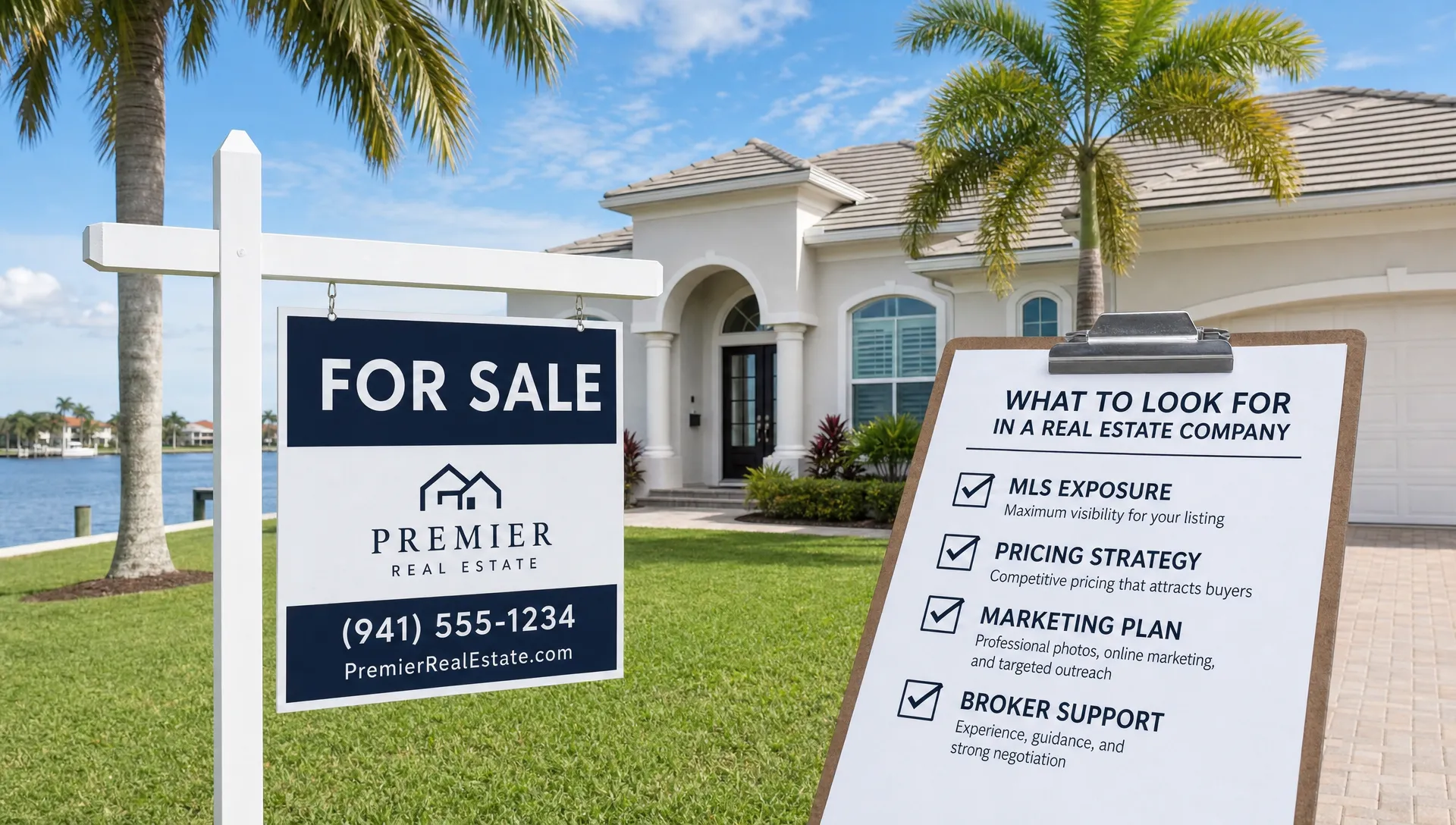
Evaluate the pricing strategy
Choosing the company that promises the highest sale price can be risky. An inflated listing price may make you feel good at the interview, but it can lead to fewer showings, longer days on market, and eventual price reductions.
A strong real estate company in Florida should be able to explain pricing with evidence. That usually includes recent comparable sales, active competition, pending listings when available, days on market, price reductions, property condition, and buyer demand in your specific area.
Florida pricing can be sensitive to costs that affect monthly affordability. Buyers may look closely at homeowners insurance premiums, flood insurance, HOA dues, condo assessments, special assessments, roof age, and required repairs. A home that looks affordable based on price alone may feel expensive once these costs are considered.
Ask the company to walk you through the pricing logic. If you are selling a condo, ask how fees, reserves, rental rules, and building condition affect buyer interest. If you are selling a waterfront or coastal property, ask how flood zones, elevation, insurance, and storm-related improvements are factored into the strategy. If you are selling in a fast-changing market, ask how often they reassess price after launch.
A good pricing conversation should feel specific, not scripted.
Get a clear picture of total costs
Commission is only one part of the financial picture. Before you sign, ask for a written breakdown of all costs, optional fees, and cancellation terms.
Depending on the company and service model, you may need to clarify:
- Listing fee or commission percentage
- Whether fees are paid upfront, at closing, or both
- Buyer broker compensation strategy and how it is documented
- Photography, signage, lockbox, showing service, or transaction coordination fees
- Administrative, compliance, or cancellation fees
- Whether contract review or negotiation help is included
- What happens if you withdraw, relist, or sell to a buyer you found yourself
Since industry practices around buyer broker compensation changed in 2024, sellers should ask how the company explains their options. You are not just deciding what you pay your listing side. You also need to understand how buyer broker compensation may affect buyer interest, negotiations, and your net proceeds.
If you are buying, ask whether a buyer commission rebate is available and whether your lender or transaction structure affects it. Rebate rules and availability can vary, so get the answer in writing before you rely on it.
Test communication before you hire
Real estate transactions involve deadlines. Inspection periods, financing contingencies, appraisal issues, HOA document review, title questions, and closing requirements all need timely communication. A company that is slow before you sign may not become faster after it has your listing.
Pay attention to how the company handles your first inquiry. Do they answer your questions directly? Do they explain tradeoffs? Do they pressure you? Do they provide written details? Do you know who your main contact will be?
For sellers, ask how showing requests, offers, counteroffers, inspection requests, and closing updates will be communicated. For buyers, ask how quickly they can schedule showings and submit offers, especially in competitive neighborhoods.
You do not necessarily need a company that answers every message within five minutes. You do need a company with a clear process, realistic response times, and accountability.
Check experience with your property type
Florida has many different property categories, and each one can require a different approach. A downtown condo in Miami is not marketed the same way as a single-family home in Sarasota, a townhouse in Orlando, a waterfront home in Naples, or an acreage property in North Florida.
Ask whether the company has experience with your type of property. This is not about demanding that they sold the house next door last week. It is about confirming that they understand the questions buyers will ask and the friction points that can delay a deal.
For condos, that may include association documents, reserves, rental restrictions, assessments, and financing requirements. For waterfront homes, it may include seawalls, docks, flood insurance, elevation, and storm exposure. For investment properties, it may include tenant occupancy, lease terms, rental income, and access for showings.
The more unusual your property, the more important this step becomes.
Watch for red flags
Most real estate companies will present themselves well during the sales conversation. Your job is to notice what they avoid, exaggerate, or cannot explain.
Be cautious if you see any of these warning signs:
- The company cannot clearly identify its Florida license or broker of record.
- They say your home will be “everywhere” but cannot name the MLS.
- They recommend a list price without reviewing comparable sales.
- They are vague about fees, cancellation terms, or what is included.
- They promise a specific sale price or timeline without market support.
- They pressure you to sign before answering basic questions.
- They do not explain who handles offers, contracts, and inspection negotiations.
- Their listing examples have poor photos, incomplete data, or generic descriptions.
One red flag does not always mean the company is wrong for you, but it should lead to more questions. A trustworthy company will welcome informed questions because it knows the answers.
Questions to ask before signing
Use your interview to compare companies consistently. These questions work whether you are considering a traditional brokerage, a flat fee MLS service, or a hybrid model.
- Are you licensed to provide brokerage services in Florida?
- Which MLS will my property be listed in, and why is that the right one?
- What services are included in the fee, and what costs extra?
- Who will prepare, review, and update my listing?
- How do you help determine the listing price?
- How are showing requests and buyer inquiries handled?
- What support do you provide with offers, counteroffers, inspections, and closing?
- How do you explain buyer broker compensation options?
- What is the cancellation policy?
- Who is my main point of contact, and how quickly should I expect responses?
Take notes during each conversation. The best choice is usually the company that gives clear, specific, written answers and whose service model matches your comfort level.
Frequently Asked Questions
What is the most important factor when choosing a real estate company in Florida? The most important factor is fit. The company should be properly licensed, understand your local MLS, know your property type, communicate clearly, and offer the level of support you need.
Should I choose the cheapest real estate company? Not automatically. A low fee can be a smart choice if the company provides the exposure and support you need. Compare total costs, MLS access, listing quality, and contract support before deciding.
Is MLS access important when selling in Florida? Yes. MLS exposure helps your property reach buyer agents, brokerage websites, and many major real estate portals. Make sure the company lists your home in the correct MLS for your area.
Can I sell my Florida home with a flat fee MLS service? Many sellers can, especially if they are comfortable managing showings and some parts of the process. You should still verify licensing, MLS coverage, support level, fees, and how offers will be handled.
What should buyers ask a Florida real estate company? Buyers should ask about local experience, representation agreements, negotiation support, availability for showings, rebate options if offered, and how the company helps evaluate insurance, HOA, condo, and inspection issues.
Choose a Florida real estate company that matches your goals
The right real estate company in Florida should give you more than a listing agreement. It should give you clarity about exposure, pricing, fees, support, and your path to closing.
If you want flexible options, NetRealtyNow offers flat fee MLS listing services and full-service real estate brokerage support, helping sellers balance commission savings with property exposure. Buyers can also ask about available commission rebate options.
Before you hire any company, compare the details in writing. The best decision is the one that protects your net proceeds, fits your comfort level, and gives your Florida transaction the support it deserves.