
A flat fee MLS listing can be a smart way to sell a Florida home without paying a traditional percentage-based listing commission. It gives your property exposure through the MLS, which is still the main source of listing data used by buyer agents and major real estate portals. For sellers who are comfortable taking a more active role, that can translate into meaningful savings.
But a flat fee listing does not make the rest of the transaction free. Florida sellers still need to budget for closing costs, state and county charges, title-related expenses, prorations, repairs and any buyer-side incentives they choose to offer. The better you understand those costs before you list, the easier it is to price correctly and avoid surprises at the closing table.
What a Florida flat fee listing actually replaces
A flat fee listing mainly changes how you pay for listing-side brokerage services. Instead of paying a listing agent a percentage of the sale price at closing, you pay a fixed listing fee for a defined set of services. Depending on the provider and package, that may include MLS entry, listing syndication, broker review, required forms, updates to the listing and some level of support.
That is different from eliminating all real estate expenses. You are still selling real property in Florida, which means you still have a contract, closing agent, title work, recording-related items, possible association documents, tax prorations and negotiated buyer requests.
If you are still comparing the basic model to a traditional listing, NetRealtyNow’s guide to what sellers should know about a flat fee MLS listing in Florida is a helpful starting point. This article focuses on the next question sellers usually ask: after the flat fee, what else am I likely to pay?
The main costs Florida sellers still pay
The exact numbers depend on your price, county, contract terms, mortgage payoff, HOA status and the buyer’s negotiation strength. Still, most Florida sellers should expect some version of the following cost categories.
| Cost category | What it covers | Can the seller control it? |
|---|---|---|
| Flat fee listing package | MLS listing setup, broker compliance review and package-specific support | Yes, by choosing the right service level |
| Marketing preparation | Photos, cleaning, staging, yard work, signs, lockbox or floor plan services | Mostly, depending on property condition and market expectations |
| Buyer broker compensation or buyer credits | Any negotiated amount paid toward the buyer’s agent or buyer costs | Yes, but buyer demand and market conditions matter |
| Documentary stamp tax on the deed | Florida transfer tax based on the sale price | Limited, the rate is set by law and contract custom affects who pays |
| Title and settlement charges | Closing agent fee, title search, owner’s title policy if seller pays and related title work | Partly, depending on county custom and negotiated contract terms |
| HOA or condo fees | Estoppel letters, transfer fees, resale documents and outstanding dues | Partly, especially by resolving balances early |
| Prorations | Property taxes, association dues, rents or other property expenses split through closing | No, but they can be estimated in advance |
| Repairs and concessions | Inspection repairs, credits, home warranty requests or price reductions | Yes, through negotiation and pre-listing preparation |
| Mortgage payoff and lien releases | Loan balance, accrued interest, payoff processing and release recording | Mostly no, but sellers can request payoff estimates early |
| Moving and holding costs | Utilities, insurance, lawn care, storage and mortgage payments while listed | Yes, through timing and preparation |
The key point is that a flat fee listing usually reduces the cost of getting your home listed and marketed through the MLS. It does not replace the financial mechanics of transferring property ownership.
The flat fee itself
Your first direct cost is the flat fee listing package. This is usually paid upfront, though package structures vary by provider. The cheapest package is not always the best fit if it leaves you paying separately for basic updates, needed support or services you assumed were included.
Before choosing a package, look closely at what happens after your listing goes live. Can you change photos, update remarks, adjust the price or mark the property pending? Is broker support included? Will the listing be syndicated to major portals? How are showing instructions handled? These details affect both your workload and your risk.
For a deeper comparison framework, review the questions in NetRealtyNow’s article on how to choose a Florida flat fee MLS listing service. A lower listing fee can be attractive, but poor MLS presentation or limited support can cost more than it saves if the home sits longer or attracts weaker offers.
Buyer broker compensation is still a strategic decision
One of the biggest points of confusion for sellers is buyer broker compensation. A flat fee listing helps you reduce or avoid a traditional listing-side commission, but it does not automatically remove all buyer-side compensation from the deal.
After the 2024 National Association of Realtors settlement practice changes, offers of buyer broker compensation are no longer displayed on many MLS platforms covered by NAR rules. NAR explains these changes in its settlement FAQ. Buyers can still have written agreements with their agents, and compensation can still be negotiated outside the MLS through the contract, a seller concession or another lawful arrangement.
For Florida sellers, the practical question is not “Do I have to offer a buyer agent commission?” It is “What strategy gives me the strongest net result?” In some markets, offering a buyer-side concession may broaden the buyer pool. In others, a well-priced property may attract buyers without one. The right choice depends on local competition, property type, price point and the financing profile of likely buyers.
A useful way to evaluate this is to compare net proceeds, not headline savings. A seller who refuses every buyer-side cost but receives a lower offer may not come out ahead. A seller who offers a targeted credit and creates more buyer demand may receive a better net price. The math should be done before listing and revisited after early showing feedback.
Florida documentary stamp tax on the deed
Florida sellers should pay special attention to documentary stamp tax, often called doc stamps. This is one of the costs that can surprise sellers because it is tied to the sale price, not the brokerage model.
According to the Florida Department of Revenue, documentary stamp tax is due on documents that transfer an interest in Florida real property. In most Florida counties, the deed tax rate is $0.70 per $100 of consideration, or portion of $100. Miami-Dade County has different rules, including a different rate structure and a surtax for many property types.
In many Florida transactions, sellers customarily pay the deed documentary stamp tax, though contract terms can shift costs. If you are estimating your net proceeds, ask your broker or closing agent to calculate this early using your expected sale price and county.
For example, on a $400,000 sale in a county where the $0.70 per $100 rate applies, the documentary stamp tax on the deed would be $2,800. That amount does not disappear because the seller used a flat fee listing.
Title insurance and closing agent fees
Title charges are another Florida-specific area where sellers need local guidance. In many counties, the seller pays for the owner’s title insurance policy. In some counties, the buyer traditionally pays. The contract can also override local custom if both parties agree.
This makes title insurance different from the flat fee listing cost. It is not a marketing expense. It is part of delivering marketable title to the buyer and closing the transaction. If there are old mortgages, judgments, estate issues, unreleased liens or name discrepancies, title work may take more time and cost more to resolve.
Sellers may also see settlement or closing fees, title search fees, lien search fees, wire fees, courier fees or recording-related charges. These vary by closing company and county. The safest approach is to request an estimated seller net sheet before you sign a contract, then update it once you have the buyer’s offer and closing date.
The Consumer Financial Protection Bureau explains the buyer-facing Closing Disclosure process, but sellers should also receive a settlement statement showing debits, credits, payoff amounts and final proceeds. Reviewing that statement carefully before closing is essential.
Property taxes, HOA dues and other prorations
Florida property taxes are generally paid in arrears, meaning the tax bill covers a period that has already passed. At closing, taxes are usually prorated so the seller is responsible for the portion of the year they owned the home and the buyer is responsible after closing. If the current tax bill is not available yet, the closing agent may estimate the proration based on the prior year’s taxes.
That estimate can matter. A homesteaded property, new construction home, recently reassessed property or home with major improvements may have tax changes that affect the buyer’s future bill. Sellers should be accurate in disclosures and should not assume last year’s tax bill represents the buyer’s future tax burden.
HOA and condo costs can also show up near closing. Florida associations often require estoppel letters or account statements confirming dues, assessments and violations. Condo associations may charge for resale documents or transfer processing. If you owe past-due assessments, special assessments, fines or violation-related charges, those may need to be resolved before closing or paid from proceeds.
Repairs, concessions and inspection negotiations
Flat fee sellers still face the same inspection dynamics as other sellers. A buyer may ask for repairs, a closing credit, a price reduction or a home warranty after inspections. You can accept, reject or counter those requests, but the outcome affects your net proceeds.
Pre-listing preparation can reduce these costs. Sellers who address obvious defects before going live often avoid last-minute renegotiations. That does not mean you need to renovate the entire home. It means fixing safety issues, visible leaks, broken fixtures, wood rot, nonworking systems and items that could create financing or insurance concerns.
This is especially relevant in Florida because wind mitigation, roof age, electrical systems, plumbing and insurance eligibility can affect buyer confidence. A home with an older roof or unresolved moisture issue may still sell, but buyers may price that risk into their offer.
Marketing costs that can be worth paying
A flat fee listing puts your home on the MLS, but MLS exposure works best when the listing is strong. Poor photos, thin remarks and missing details can reduce showing activity even if the property is technically visible everywhere it needs to be.
Professional photography is often worth considering, especially in competitive Florida markets where buyers compare homes online before scheduling a showing. Some sellers also pay for deep cleaning, landscaping, minor staging, twilight photos, floor plans or virtual tour services. These are optional costs, but they can influence first impressions.
The question is not whether every seller needs premium marketing. The better question is whether a specific marketing expense is likely to improve buyer response enough to justify the cost. A vacant luxury waterfront property has different needs than a clean, entry-level townhouse in a low-inventory neighborhood.
Mortgage payoff, liens and seller obligations
If you have a mortgage, your loan payoff will be deducted from sale proceeds at closing. This is not a selling fee, but it is often the largest deduction on the settlement statement. Payoff amounts can include principal, accrued interest through the payoff date and lender processing charges.
Sellers should also identify any other liens early. Common issues include home equity lines of credit, solar panel financing, municipal liens, code enforcement fines, contractor liens, unpaid association balances and old mortgages that were paid but never properly released. A flat fee MLS package does not remove the need to clear title.
If you are unsure what may appear, ask the closing agent or title company when title search work begins. Waiting until the week of closing can create avoidable stress and may delay funding.
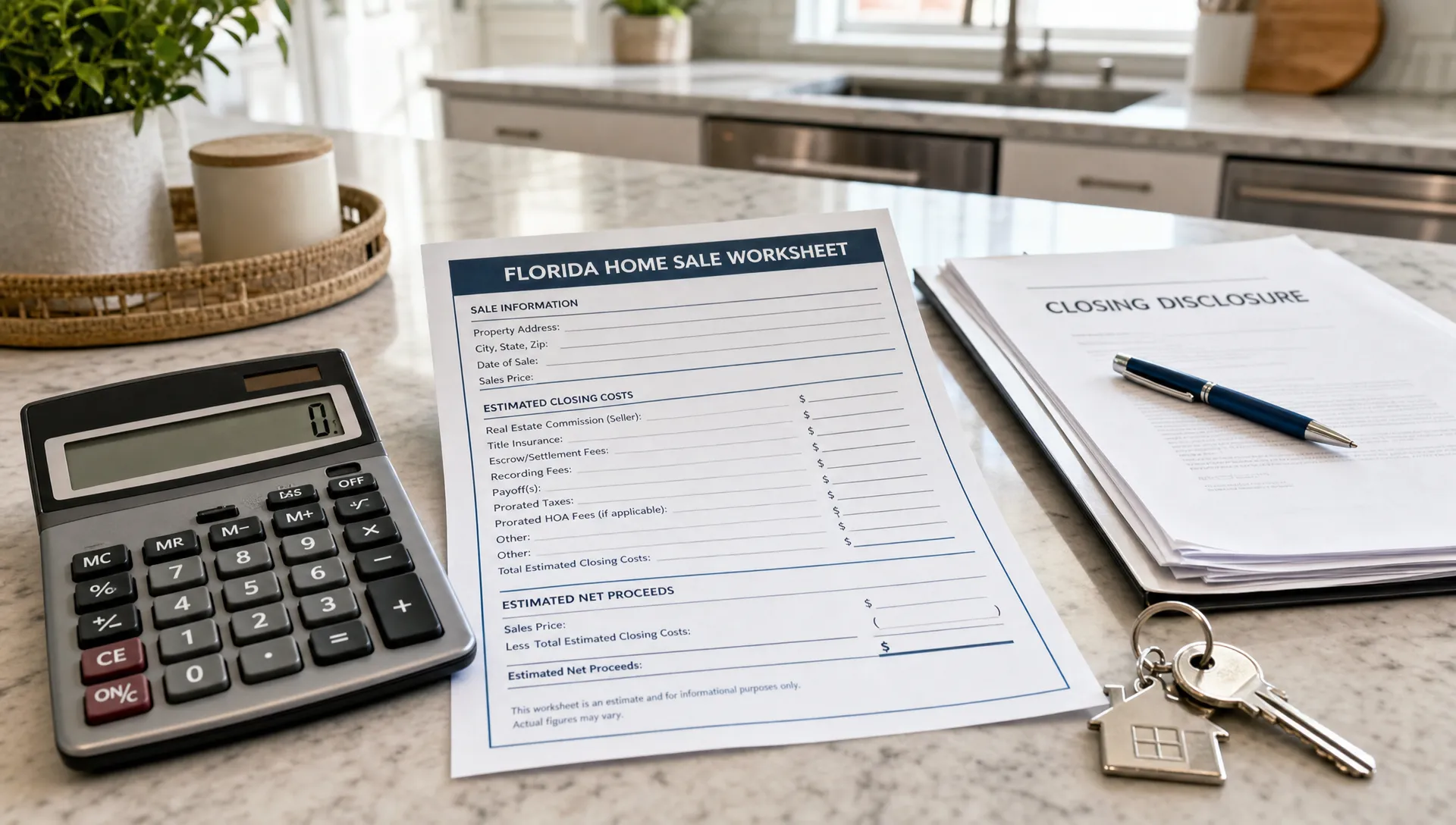
A simple way to estimate your net proceeds
Before listing, build a rough seller net sheet. It does not need to be perfect, but it should be detailed enough to show whether your target price supports your goals.
| Line item | How to estimate it |
|---|---|
| Expected sale price | Use recent comparable sales, not only active listing prices |
| Flat fee package | Use the provider’s stated package price and any selected add-ons |
| Buyer-side compensation or credit | Model several scenarios, including no credit and negotiated credit options |
| Documentary stamp tax | Calculate based on Florida and county rules for your sale price |
| Title and settlement costs | Request an estimate from a local closing agent or title company |
| Mortgage payoff | Ask your lender for an estimated payoff amount |
| Tax and HOA prorations | Estimate based on closing date, dues and current or prior tax bills |
| Repairs and concessions | Set aside a realistic cushion based on property condition |
| Moving and holding costs | Include utilities, insurance, storage, lawn care and overlap housing costs |
This exercise helps sellers avoid a common mistake: focusing only on commission savings while underestimating the rest of the transaction. For a broader checklist of possible add-ons and fee questions, NetRealtyNow’s breakdown of flat fee listing costs and hidden fees is a useful companion.
When a flat fee listing may not be the lowest-risk option
A flat fee listing can be a strong fit for sellers who are organized, responsive and comfortable managing showings, offer review and negotiations with appropriate support. It may be less ideal if you are out of state, dealing with a complicated title issue, selling a tenant-occupied property or facing a high-stakes relocation timeline.
That does not mean you must default to a traditional commission model. It means you should match the service level to the transaction. Some sellers benefit from a flat fee MLS package, while others need more agent involvement with pricing, negotiation, inspection coordination or contract management.
NetRealtyNow offers both flat fee MLS listing services and full-service brokerage options, so sellers can choose a level of support that fits their situation rather than forcing every sale into the same model.
Frequently Asked Questions
Do Florida flat fee listings eliminate commission completely? Not always. A flat fee listing can reduce or replace the traditional listing-side commission, but sellers may still negotiate buyer broker compensation, buyer credits or other concessions depending on the offer and market conditions.
Who pays closing costs in a Florida flat fee sale? The listing model does not decide closing costs. Florida closing costs are controlled by the contract, county custom and the parties’ negotiations. Sellers commonly pay certain items such as deed documentary stamps and, in many counties, owner’s title insurance, but details vary.
Does the MLS fee include title work or documentary stamp tax? No. The flat fee generally covers listing-related services, not government transfer taxes, title insurance, settlement fees, mortgage payoff or association charges.
Can I refuse to pay a buyer agent fee in Florida? Buyer broker compensation is negotiable. Sellers can decide their strategy, but they should evaluate how that decision may affect buyer demand, offer strength and net proceeds.
What is the biggest surprise cost for Florida sellers? Documentary stamp tax, title-related charges, HOA or condo estoppel fees, inspection concessions and tax prorations are among the most common surprises. A seller net sheet prepared before listing can reduce that risk.
Selling with savings starts with knowing the full number
Florida flat fee listings can help sellers reduce listing-side costs while keeping MLS exposure, but the smartest sellers budget beyond the listing fee. Closing costs, doc stamps, title charges, prorations and negotiations still matter.
If you are preparing to sell in Florida, start with a clear estimate of your net proceeds and choose the service level that matches your experience, timeline and comfort with the process. NetRealtyNow can help you compare flat fee MLS and full-service options so you can list with a plan, not a guess.