
A buyer can browse homes online for months without being ready to schedule a showing. A serious buyer is different. They have a defined search area, understand their budget, may already be working with an agent or lender, and can move quickly when the right property appears.
That is why MLS house listings matter so much for sellers. The Multiple Listing Service is not just another website where your home appears. It is the data source that many agents, broker websites, saved-search alerts, and major real estate portals rely on to match active buyers with available homes.
When your home is entered correctly into the MLS, it reaches the people most likely to take the next step: buyers who are actively comparing homes, scheduling tours, and writing offers.
Why MLS house listings attract more serious buyers
Public real estate portals are useful, but they include every kind of visitor. Some people are casually checking home values. Some are looking at dream homes outside their budget. Some are neighbors who are simply curious.
The MLS works differently because it is built around real estate transactions. Licensed professionals use it to find homes for qualified clients, track listing status, compare properties, schedule showings, and prepare offers. According to the National Association of Realtors Profile of Home Buyers and Sellers, buyers continue to rely heavily on both online search and real estate professionals during the home-buying process.
That combination is powerful for sellers. The MLS puts your home into the systems buyers and agents use when they are ready to act, not just when they are browsing.
How a listing moves from the MLS to buyers
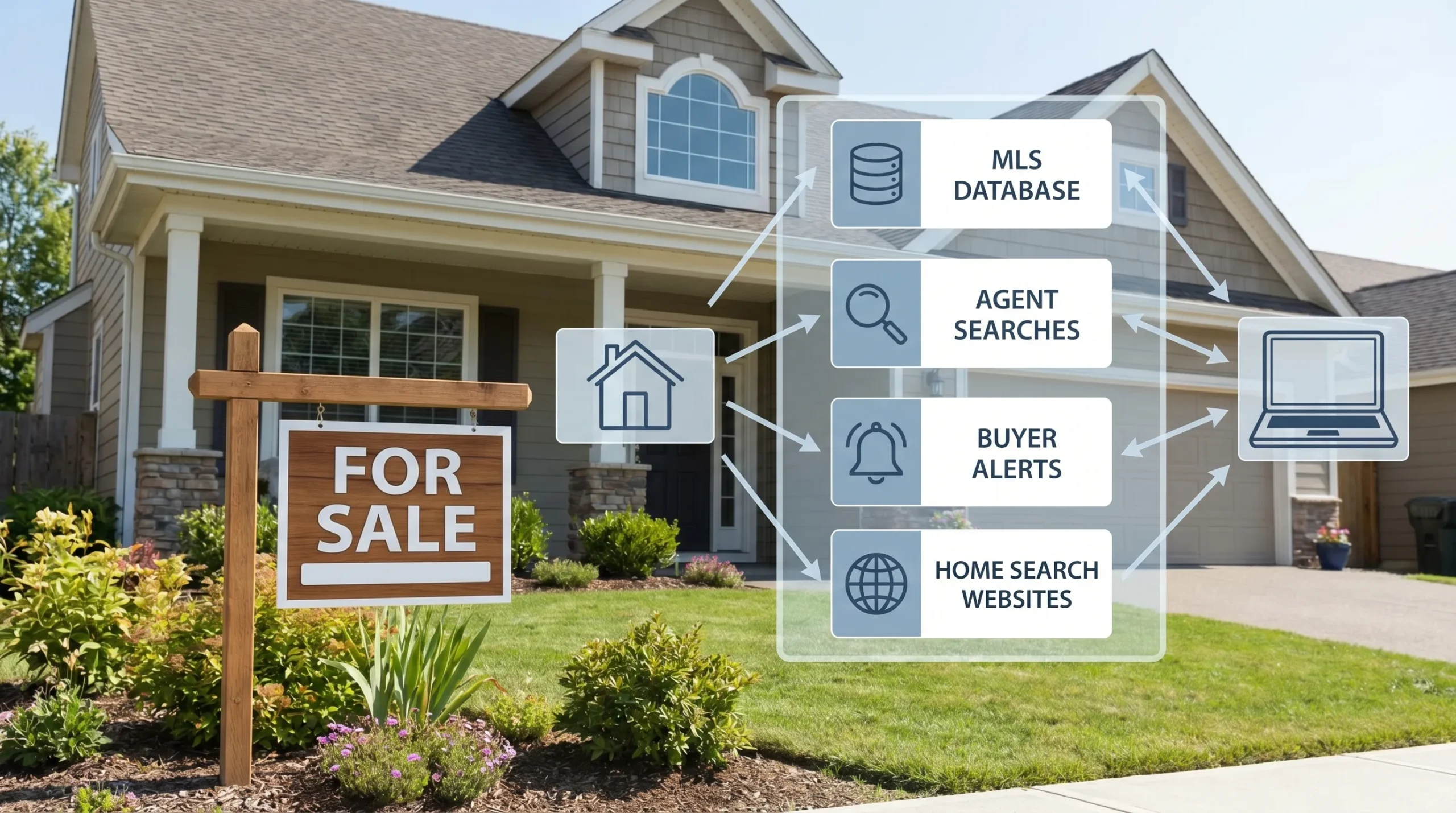
A properly submitted MLS listing can travel through several layers of visibility. This is one reason MLS exposure is often the foundation of a strong home-selling strategy.
- A licensed broker enters the property into the local MLS: The listing includes structured data such as price, address, beds, baths, square footage, property type, photos, showing instructions, remarks, and other required fields.
- Agents see the listing in their MLS searches: Buyer agents can find the home based on their clients' exact criteria, including price range, neighborhood, property features, and listing status.
- Saved searches notify active buyers: Many buyers receive automatic alerts from their agents or broker websites when a new home matches their search.
- IDX and broker websites display the listing: Many real estate brokerage sites pull listing data from MLS feeds, giving the property more online reach.
- Major portals may receive the listing through syndication: Sites like Realtor.com, Zillow, Redfin, Homes.com, and other platforms often display MLS-fed listings, depending on syndication rules and broker settings.
- Showing requests and buyer inquiries begin: Interested buyers can contact their agent, request a showing, or ask for more information based on the MLS data.
This chain matters because it does more than create visibility. It creates organized, searchable, and action-oriented visibility.
MLS exposure is different from general online exposure
More views are not always better. A home can receive thousands of casual views and still generate few showings if it is not reaching the right audience.
MLS exposure helps filter attention toward buyers who are searching with more intent. These buyers are often working within a budget, comparing similar homes, and monitoring new listings because they are prepared to make decisions.
| Marketing channel | Who it often reaches | Main strength | Main limitation |
|---|---|---|---|
| MLS | Agents and active buyers using structured searches | High-intent exposure and accurate listing data | Requires broker access |
| Major portals | Broad public audience | Large consumer reach | Includes many casual browsers |
| Social media | Local networks and interest-based audiences | Fast sharing and visual appeal | Search intent can be low |
| Yard sign | Nearby traffic and neighbors | Local visibility | Limited reach beyond the immediate area |
| FSBO-only sites | Buyers searching owner-listed homes | Direct seller contact | Smaller buyer pool than MLS-fed channels |
The best approach is usually not MLS versus portals. It is MLS as the foundation, with portals and other channels extending the reach.
Serious buyers rely on accurate listing data
A strong MLS listing is valuable because buyers can filter it, compare it, and trust it more easily. The fields inside the listing help determine whether the home appears in the right searches.
For example, a buyer looking for a three-bedroom home under a specific price in a particular school district may never see your property if the listing data is incomplete or entered incorrectly. A buyer who needs a main-level bedroom may skip a listing if that feature is not clear. A buyer with a strict closing timeline may hesitate if occupancy or availability details are vague.
Accuracy also helps agents. Buyer agents do not want to waste time showing homes that do not match their clients' needs. When your MLS listing is complete, agents can quickly determine whether the home is worth recommending.
The most important MLS details usually include price, property type, room count, square footage, lot information, HOA or condo fees, tax details, showing availability, disclosures, included appliances, parking, and special features. Not every field applies to every home, but every relevant field should be handled carefully.
The role of agent search behavior
One of the biggest advantages of MLS house listings is that they fit directly into agent workflows. Agents often set up saved searches for buyers based on precise requirements. When a new property matches those requirements, the buyer may receive an alert within a short time.
That creates an important launch-window advantage. A new MLS listing can appear in front of the right buyers quickly, especially if it is priced well and photographed well. In competitive price ranges, early visibility can lead to fast showings and stronger interest.
Agents also monitor listing status changes. A price reduction, back-on-market status, open house update, or change in showing availability can bring renewed attention to a listing. This makes the MLS useful not only on launch day, but throughout the marketing period.
What makes an MLS listing more appealing to ready buyers
Getting into the MLS is important, but the quality of the listing determines how well that exposure performs. Serious buyers are comparing your home against alternatives. They need enough information to decide whether your property is worth their time.
| Listing element | Why it matters to serious buyers | Seller tip |
|---|---|---|
| Competitive price | Buyers search in price brackets and compare value quickly | Review recent comparable sales before going live |
| Strong first photo | The main image affects clicks and first impressions | Use a bright, clear exterior or best interior feature photo |
| Complete MLS fields | Filters determine whether buyers even see the home | Fill in all relevant property details accurately |
| Clear remarks | Buyers want specifics, not generic claims | Highlight upgrades, layout, location, and practical benefits |
| Showing access | Serious buyers often need to tour quickly | Offer reasonable showing windows whenever possible |
| Updated status | Agents rely on status accuracy before recommending a tour | Keep active, pending, and back-on-market details current |
| Disclosures and documents | Prepared buyers want fewer surprises | Provide required documents promptly through proper channels |
A listing does not need exaggerated language to perform well. In fact, serious buyers often prefer clarity. Specific details such as roof age, recent HVAC replacement, parking arrangements, condo fees, outdoor space, storage, or commuting access can be more persuasive than broad phrases like must-see or perfect home.
MLS syndication expands reach beyond the agent network
Many sellers first think of MLS exposure as agent exposure, but MLS data also supports wider online distribution. Depending on your market, broker settings, and listing package, your property may appear across major consumer search sites and brokerage websites.
NetRealtyNow, for example, offers flat fee MLS listing services designed to place homes in the MLS and distribute listings across 80+ portals. That gives sellers a way to reach both agent-connected buyers and consumers searching independently online.
This broader reach matters because buyers do not all search the same way. One buyer may rely heavily on their agent. Another may check Redfin or Realtor.com every morning. Another may find the home first on a portal and then ask their agent to schedule a showing. MLS-based distribution helps your listing meet buyers across those different paths.
If you want a deeper look at how exposure affects selling speed, see NetRealtyNow's guide on how MLS real estate exposure helps homes sell faster.
Flat fee MLS can reach serious buyers without a traditional listing commission
A common misconception is that sellers need a traditional full-service listing agreement to reach MLS buyers. In many markets, a flat fee MLS service can provide the same core MLS exposure through a licensed broker while allowing the seller to stay more involved in the process.
This can be attractive for sellers who are comfortable handling showings, communicating with buyers or buyer agents, reviewing feedback, and making decisions quickly. The seller gets access to the MLS distribution engine while potentially saving on the listing-side commission.
That said, the right service level depends on your situation. A straightforward property with strong comparable sales and a local, responsive seller may be a good fit for flat fee MLS. A complex sale, unusual property, estate situation, tenant-occupied home, or seller who wants hands-on guidance may benefit from full-service brokerage support.
NetRealtyNow offers both flat fee MLS listing services and full-service real estate brokerage options, so sellers can choose the amount of support that matches their needs. If you are still comparing models, the guide on what to expect from a flat fee MLS service can help clarify the tradeoffs.
Serious buyers still need confidence after they click
MLS visibility gets buyers to notice your home. The next step is confidence. Buyers want to feel that the home is accurately represented, easy to tour, and worth pursuing.
Photos should show the actual condition and layout of the property. Descriptions should be specific but not misleading. If there are known limitations, required disclosures, HOA restrictions, or occupancy constraints, those issues should be handled properly rather than hidden.
This is especially important in a market where buyers are carefully watching affordability. Mortgage rates, insurance costs, taxes, HOA fees, and repair concerns can all affect whether a buyer moves forward. Clear listing information reduces uncertainty and helps serious buyers make faster decisions.
Listing data, permissions, and trust all matter
The MLS is not just a marketing platform. It is a controlled data system with rules about accuracy, broker participation, listing permissions, photography, fair housing compliance, and status updates. Sellers should take those rules seriously because inaccurate or unauthorized listing content can create delays, corrections, or disputes.
This is similar to a broader digital principle: distribution works best when rights and permissions are clear. In other industries, platforms such as Third Chair help rights holders monitor, enforce, and license intellectual property usage. In real estate, MLS rules, broker agreements, and proper photo permissions serve a similar trust-building purpose for listing data.
For sellers, the practical takeaway is simple. Use photos you have the right to use, provide accurate property information, review your listing carefully, and work with a broker or listing service that understands local MLS requirements.
Common mistakes that reduce MLS buyer interest
Even with MLS exposure, some listings underperform because they create friction for serious buyers. The most common issues are usually avoidable.
- Overpricing the home at launch: Buyers and agents compare your home to recent sales and active competition. If the price is too high, strong buyers may wait for a reduction instead of scheduling a showing.
- Using weak or incomplete photos: Dark, cluttered, or poorly ordered photos can make buyers skip the listing before reading the details.
- Leaving key MLS fields blank: Missing data can keep your home out of buyer searches or create uncertainty.
- Making showings difficult: Limited access can push buyers toward easier alternatives, especially if they are touring several homes in one day.
- Responding slowly to inquiries: Serious buyers often move fast. Delayed responses can cost momentum.
- Letting the listing become stale: If activity slows, sellers should evaluate pricing, presentation, and market feedback rather than waiting indefinitely.
MLS exposure is powerful, but it is not magic. It works best when the listing is accurate, attractive, accessible, and priced in line with the market.
How to know if your MLS listing is reaching the right buyers
Once your listing is live, pay attention to the quality of the response. Views and online saves can be useful, but showings, agent feedback, repeat interest, and offers are stronger signals.
If your listing receives many views but few showings, buyers may like the idea of the home but hesitate because of price, photos, location, condition, or missing information. If showings happen but no offers follow, feedback may point to condition, layout, needed repairs, or value compared with competing homes. If there are few views and few showings, the issue may be search visibility, pricing, photos, or listing distribution.
A good broker or listing support team can help interpret these signals. The goal is not simply to be online. The goal is to convert visibility into qualified showings and serious offers.
Frequently Asked Questions
Do MLS house listings only reach buyers with agents? No. MLS listings primarily serve agents and broker systems, but they often syndicate to public portals and brokerage websites as well. This means they can reach both agent-represented buyers and consumers searching on their own.
Are MLS buyers more serious than portal visitors? Often, yes. Portals attract a wide audience, including casual browsers. MLS-connected buyers are more likely to be working with agents, using saved searches, comparing active inventory, and preparing to tour or make offers.
Can a flat fee MLS listing reach the same buyers as a traditional listing? A flat fee MLS listing can provide core MLS exposure through a licensed broker, which helps the property appear in agent searches and syndicated channels. The difference is usually the level of service and support, not the basic MLS visibility.
How fast will buyers see my home after it is listed in the MLS? Timing depends on the MLS, broker review process, syndication feeds, and portal update schedules. Agents and saved-search buyers may see the listing quickly, while third-party websites can take longer to update.
What makes buyers skip an MLS listing? Common reasons include overpricing, poor photos, missing details, difficult showing access, unclear property condition, or a listing description that does not answer practical buyer questions.
Get your home in front of more serious buyers
If you want broad exposure without unnecessary commission costs, MLS visibility is one of the most important steps you can take. A well-prepared MLS listing can reach agent-connected buyers, online searchers, and major real estate portals while giving serious buyers the information they need to act.
NetRealtyNow helps sellers list through flat fee MLS options and full-service brokerage support, depending on how much assistance they want. With online listing submission, broker support, and distribution to 80+ portals, sellers can choose a practical path to stronger exposure.
To explore your options, visit NetRealtyNow and choose the listing approach that fits your home, your market, and your preferred level of support.