
Comparing homes for sale listings can feel simple until you have 27 browser tabs open, three different apps showing different statuses, and every kitchen starts to look the same. The fastest buyers are not always the ones who see the most listings. They are the ones who know how to eliminate poor fits quickly and rank the strongest options with a repeatable process.
A good comparison system helps you answer three questions fast: Is this home a real fit? Is the price and cost structure workable? Is it worth taking action now? Here is a practical way to compare listings faster without overlooking the details that matter.
Start With a Clear “No” List
Before you compare homes, define what makes a listing an automatic pass. This is different from a wish list. A wish list includes things you would like, such as a finished basement, updated kitchen, or large deck. A “no” list includes deal breakers that make a home not worth your time.
Your no list might include a maximum commute, minimum bedroom count, property type, school boundary, HOA restrictions, flood zone concerns, or a hard monthly payment ceiling. The point is to protect yourself from emotionally debating homes that cannot realistically work.
A strong rule of thumb is this: if a listing fails a nonnegotiable requirement, do not save it “just in case.” That one habit can cut your comparison time dramatically.
Compare the Same Details Every Time
Homes are marketed differently, so buyers often compare them unevenly. One listing may have polished photography, another may have sparse photos but better square footage, and another may look affordable until you notice the taxes or HOA fee. To move faster, standardize your review.
Use the same five-part scan for every listing: location, price, layout, condition, and urgency. This keeps you from getting distracted by staging, camera angles, or emotional language in the description.
| Listing detail | What to check quickly | Why it matters |
|---|---|---|
| Location | Commute, school boundary, road noise, nearby uses | A great house in the wrong spot is rarely a good fit |
| Price | List price, estimated payment, taxes, HOA fees | List price alone does not show affordability |
| Layout | Bedrooms, bathrooms, stairs, room flow, work-from-home space | Square footage can be misleading without functional layout |
| Condition | Age of roof, systems, windows, visible repairs | Condition affects budget, inspections, and negotiation |
| Urgency | Days on market, status, price changes, showing availability | Helps you decide whether to tour now or watch |
If you are still refining your search criteria, it can help to first review how to search MLS listings more effectively so your comparison pool is cleaner from the start.
Use a 5-Minute First-Pass Review
The goal of the first pass is not to decide whether to buy the home. It is to decide whether the listing deserves more time. Give yourself about five minutes per property and move through the same sequence.
First, confirm the basics: price, location, beds, baths, property type, and status. Then check the map before you study the photos. Buyers often fall in love with interior images before noticing the home backs to a busy road or sits outside their preferred area.
Next, scan the photo set for layout and condition clues. Do not judge only by finishes. Look for ceiling height, natural light, room proportions, storage, basement condition, exterior grading, roof appearance, and whether major rooms are missing from the photo set.
Finally, read the remarks for facts, not adjectives. Phrases like “move-in ready” and “won’t last” are less useful than details about updates, age of systems, included appliances, HOA rules, parking, or recent improvements.
Build a Simple Listing Scorecard
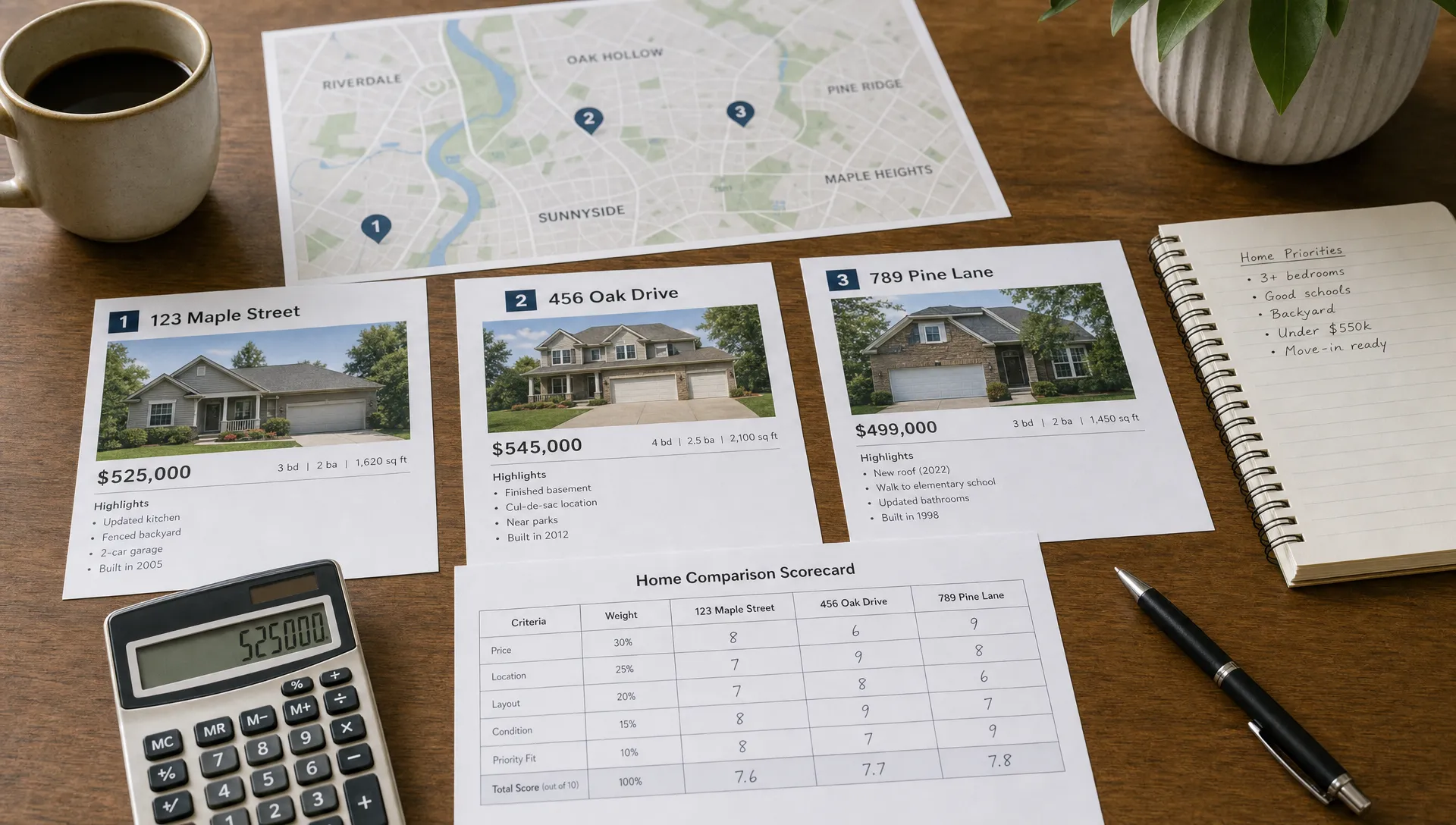
A scorecard prevents every home from feeling like a fresh debate. You do not need a complicated spreadsheet. A basic 1-to-5 rating system is enough to compare homes for sale listings faster and keep your shortlist objective.
Rate each property on these categories:
- Location fit
- Monthly cost fit
- Layout and size
- Condition and repair risk
- Resale potential
- Urgency to act
Then add a short note with the reason for the score. For example, “great layout but high taxes,” “excellent location but dated systems,” or “priced well, needs immediate tour.” The note matters because after a week of searching, listings blur together.
A home with a slightly lower overall score may still be worth touring if it is strong in your top priorities. The scorecard is not meant to replace judgment. It gives you a faster way to focus your judgment.
Compare Monthly Cost, Not Just List Price
Two homes listed at the same price can have very different ownership costs. Property taxes, insurance, HOA dues, utilities, maintenance, and commuting costs can change the real affordability picture.
For a faster comparison, create a rough monthly cost view for each serious contender. Include principal and interest based on your lender’s estimate, property taxes, insurance estimate, HOA fees if applicable, and any obvious near-term maintenance. If you are comparing loan options, the Consumer Financial Protection Bureau explains how to use a Loan Estimate to review costs more consistently.
Do not rely on portal payment estimates as your final number. They are useful for a quick screen, but they may not reflect your actual loan terms, insurance, tax assumptions, or local fees. When a property makes your top tier, verify the numbers with your lender or agent.
Read Photos Like a Buyer, Not a Browser
Listing photos are designed to attract attention, not necessarily to answer every practical question. A fast comparison process means learning what the photo set is telling you and what it might be leaving out.
Wide-angle photos can make rooms feel larger than they are. Heavy staging can hide limited storage or awkward traffic flow. A listing with many close-ups of decor but few full-room shots may require extra scrutiny. Missing exterior, basement, bathroom, or mechanical photos are not automatic red flags, but they are reasons to ask questions before spending time on a showing.
Look at the sequence of images too. A complete photo set usually helps you understand how spaces connect. If you cannot tell where the dining area, kitchen, bedrooms, and outdoor areas sit in relation to one another, the home may need a floor plan, video walkthrough, or in-person tour before you can compare it fairly.
Check the Map Before You Fall for the House
Location research can eliminate weak matches faster than almost any other step. Once a listing passes your first screen, zoom in on the map and look beyond the pin.
Check the street type, nearby intersections, commercial properties, train lines, power lines, parks, schools, and water features. In some markets, flood risk can be a major factor, so you may want to review the FEMA Flood Map Service Center or ask your agent for local context.
Also compare what daily life would feel like. A home may be five miles from work but take 30 minutes during rush hour. Another may be farther away but have a smoother commute. Grocery stores, childcare, healthcare, public transportation, and parking can all affect your satisfaction more than a cosmetic upgrade inside the house.
Sort Listings Into Three Buckets
After your first-pass review and scorecard, do not leave every saved home in one long list. Sort each listing into a decision bucket.
| Bucket | What it means | Next action |
|---|---|---|
| Tour now | Strong fit, acceptable cost, and likely competition | Schedule a showing quickly |
| Watch closely | Good potential but one or two concerns | Track price, status, and new information |
| Pass | Fails a deal breaker or ranks poorly | Remove it from your active list |
The “watch closely” bucket is where buyers often lose time. It is fine to monitor homes, but do not let maybes crowd out better opportunities. If a watched listing gets a price cut, adds new photos, or sits longer than expected, you can reassess. Otherwise, keep your active comparison list lean.
Pay Attention to Status and Days on Market
Listing status can change quickly. Depending on your market and MLS rules, you may see statuses such as active, coming soon, active under contract, contingent, or pending. These labels do not always mean the same thing in every area, so ask your agent how local status terms work.
Days on market also need context. A home with one day on market may require quick action if it is priced well in a competitive neighborhood. A home with 60 days on market may have negotiation room, but it may also have condition issues, pricing concerns, or buyer objections that are not obvious online.
Price history is especially useful. A recent price reduction can move a listing from “watch” to “tour now.” Multiple reductions may signal opportunity, but they can also suggest the seller started too high or the market is rejecting something about the property.
Use Alerts, But Keep Them Narrow
Alerts are only helpful if they send you listings you can actually use. If your alert criteria are too broad, you will spend more time deleting homes than comparing them. If they are too narrow, you may miss a good fit.
Set alerts around your true buying range and primary locations, then create a second broader search for edge cases. For example, your main alert might include your target neighborhoods and must-have bedroom count. Your secondary alert might include nearby areas or homes slightly above budget in case of price reductions.
Fresh data matters because attractive listings can move quickly. If speed is a priority in your market, learn how to find fresh listings before other buyers do and combine those alerts with your scorecard system.
Know When a Listing Deserves a Tour
A listing does not need to be perfect to deserve a showing. It needs to be promising enough that the unknowns are worth investigating.
Consider touring when the home meets your core requirements, the monthly cost appears workable, the location passes your map check, and the photos raise questions that cannot be answered online. In-person tours are especially useful for judging noise, natural light, room flow, storage, odors, exterior maintenance, and the feel of the surrounding street.
On the other hand, skip the tour when the listing fails a nonnegotiable requirement, depends on unrealistic renovation assumptions, or only works if the seller accepts a price far below what the market suggests. Touring fewer but better homes is usually faster than seeing everything.
Compare With Resale in Mind
Even if you plan to stay for years, resale potential should be part of your comparison. The features that make a home easier for you to buy later may also make it easier to sell.
Strong resale factors often include a practical layout, good natural light, adequate parking, functional outdoor space, reasonable taxes or HOA fees, and a location that appeals to a wide pool of future buyers. Highly unusual layouts, major deferred maintenance, limited financing options, or location challenges may require a bigger discount to make sense.
The goal is not to buy only the safest or most conventional home. It is to understand what trade-off you are making before you compete for it.
Frequently Asked Questions
What is the fastest way to compare homes for sale listings? Use the same checklist for every property: location, total monthly cost, layout, condition, and urgency. Then sort each listing into tour now, watch closely, or pass.
How many homes should I keep on my shortlist? Most buyers move faster with a shortlist of 5 to 10 serious options. If your list is much larger, your criteria may be too broad or you may be keeping homes that fail important requirements.
Should I trust home value estimates on listing sites? Online estimates can be useful as a starting point, but they are not a substitute for local comparable sales, property condition, and current market demand. Use them as one input, not the final answer.
Why do different websites show different listing statuses? Some sites update faster than others, and data feeds can vary. MLS-connected information is often more current, but you should confirm status with an agent before assuming a home is still available.
When should I schedule a showing instead of continuing to compare online? Schedule a showing when a home meets your core requirements, appears affordable, has a strong location, and has unknowns that matter. Online research is useful, but it cannot fully replace seeing the property in person.
Move Faster With Better Listing Data
Comparing homes gets easier when you stop treating every listing like a blank slate. Use a clear no list, a repeatable scorecard, realistic monthly cost checks, and focused alerts. You will spend less time scrolling and more time acting on homes that truly fit.
If you are buying or selling in a market served by NetRealtyNow, explore how NetRealtyNow supports real estate consumers with brokerage services, flat fee MLS listing options, and buyer commission rebates where available.