
When a home sells quickly, it is rarely because it was posted in one place and buyers magically appeared. Fast sales usually come from a chain reaction: the listing enters the right data systems, appears in buyer searches, triggers alerts, gets shared across major portals, and gives serious buyers enough confidence to schedule a showing.
That is the real value of real estate listing sites. They do not replace pricing strategy, presentation, or negotiation, but they make all of those efforts visible to the people most likely to act.
For today’s sellers, especially those comparing flat fee MLS, full-service brokerage, and FSBO options, understanding how listing sites work can help you make smarter decisions before your home goes live.
What counts as a real estate listing site?
A real estate listing site is any online platform where homes for sale can be searched, filtered, viewed, and shared. Some sites are designed for licensed agents, while others are built for consumers. The important point for sellers is that not all listing sites carry the same weight.
The MLS, or multiple listing service, is usually the foundation. It is the professional database agents use to enter, update, and search listings. From there, many listings syndicate to consumer-facing websites such as major portals, brokerage IDX websites, and other online destinations.
Public portals are where many buyers browse. MLS-connected agent tools are where many serious searches are organized. A strong selling strategy usually uses both.
| Listing channel | Who primarily uses it | How it can speed up a sale | Main limitation |
|---|---|---|---|
| MLS | Agents and brokerages | Reaches buyer agents, saved searches, and local market systems quickly | Sellers generally need broker access |
| Major real estate portals | Buyers and casual browsers | Creates broad consumer visibility and easy sharing | Data may depend on MLS feeds and portal rules |
| Brokerage IDX websites | Buyers working with agents | Puts listings in local broker search tools and alerts | Traffic varies by brokerage site |
| FSBO and classified sites | DIY sellers and bargain-focused buyers | Adds supplemental exposure | May not reach as many agent-represented buyers |
| Social media and local groups | Local networks and niche audiences | Can create quick awareness and shares | Less structured search data and buyer qualification |
The fastest results usually come when your home is not dependent on one website. A listing that starts in the MLS and then appears across multiple portals has a much better chance of meeting buyers where they already search.
Why listing sites help homes sell faster
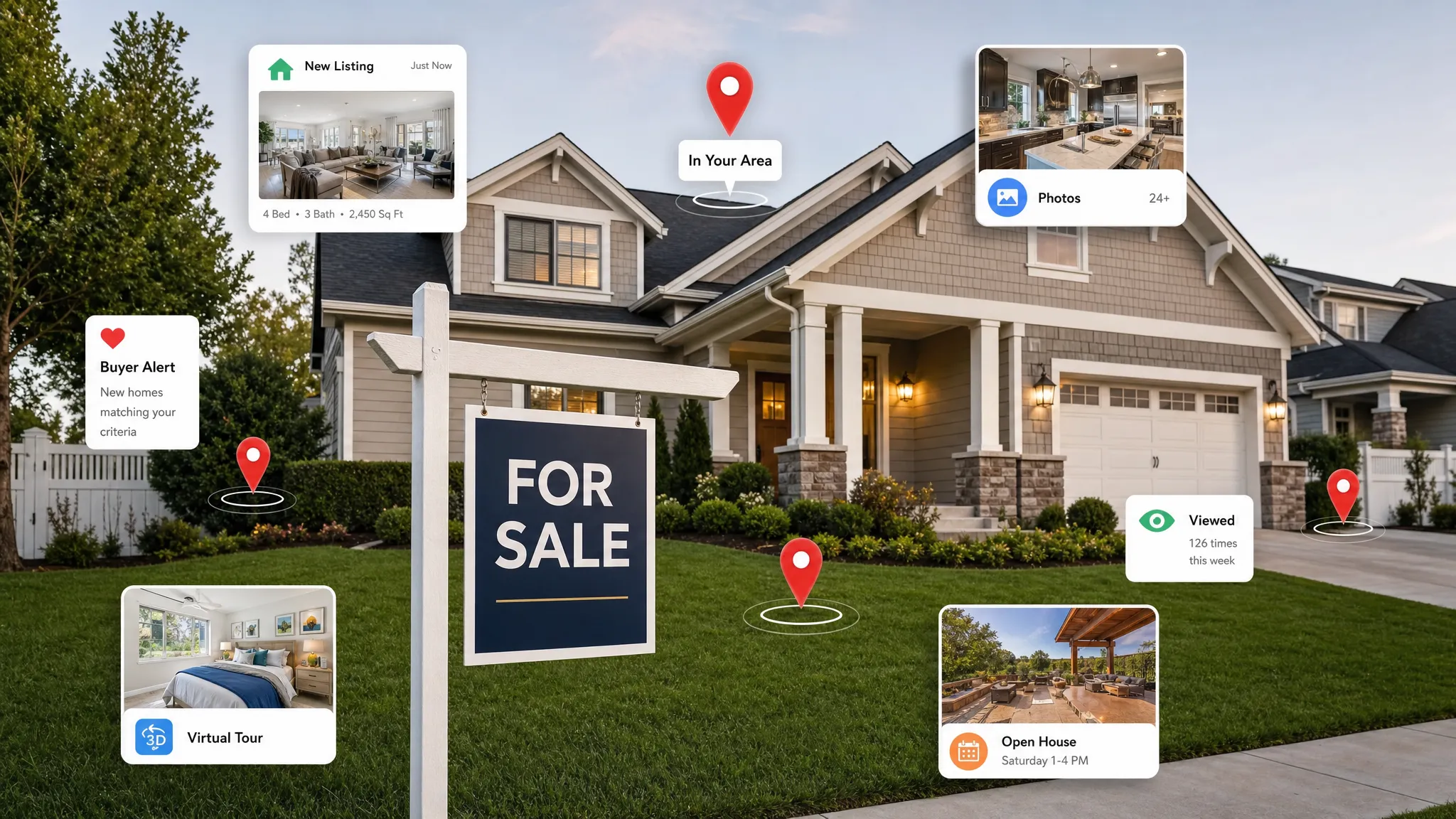
Real estate listing sites help shorten the time between “listed” and “showing request” because they reduce friction. Buyers can find the property, compare it, save it, send it to an agent, and decide whether to tour it without waiting for a flyer, sign call, or open house.
They put your home in front of active buyers
A buyer scrolling through listings is not the same as a person casually seeing a yard sign. Online searchers are often filtering by price, location, bedrooms, property type, school area, commute, lot size, and other criteria. If your listing matches those filters, it can appear at the exact moment a buyer is looking for that type of home.
This is especially important during the first few days on market. New listings often get heightened attention because buyers and agents are watching for fresh inventory. If the property is priced and presented well, early exposure can lead to fast showings and, in stronger market conditions, earlier offers.
They trigger saved searches and alerts
Many buyers do not manually search from scratch every day. They set up alerts. Their agent may also create MLS-based searches that notify them when a home fits their criteria.
That means a listing site is not just a passive webpage. It can act like a notification system. When your home goes live with the right price, location, property details, and status, it can be pushed to buyers who are already waiting for a matching property.
For sellers, this makes listing accuracy critical. If the square footage, bedroom count, property type, HOA details, or location fields are entered incorrectly, your home may miss the searches it should appear in.
They make comparison easier for serious buyers
Buyers rarely evaluate a home in isolation. They compare it with other active listings, recently sold homes, price reductions, and pending properties. Listing sites make that comparison easier.
This can work in your favor if your home is positioned well. A clean listing with strong photos, complete details, and a competitive price can stand out against homes with poor presentation or unrealistic pricing. On the other hand, if your listing looks weaker than nearby competition, online comparison can slow activity quickly.
They help buyers self-qualify before scheduling
A fast sale does not come from maximum curiosity. It comes from qualified interest. Good listing sites allow buyers to review the essentials before they request a showing.
Details such as taxes, HOA fees, room counts, parking, school information, lot size, disclosures, showing instructions, and property condition signals can help buyers decide whether the home fits their needs. When buyers have better information upfront, showings are more likely to come from people who are genuinely interested.
The listing quality still determines the result
Exposure alone does not sell a home. If two homes appear on the same websites, the one with better pricing, photos, description, and showing access usually has the advantage.
Real estate listing sites amplify your strategy. If the strategy is strong, they help it travel faster. If the strategy is weak, they expose the weaknesses to more buyers.
| Speed factor | How listing sites help | What the seller should do |
|---|---|---|
| Pricing | Buyers compare your home instantly against alternatives | Use recent comparable sales and current competition |
| Photos | Thumbnails determine whether buyers click | Use bright, clear, well-composed images |
| Listing details | Search filters rely on structured fields | Complete every relevant MLS field accurately |
| Description | Helps buyers understand lifestyle and value | Lead with specific benefits, not generic adjectives |
| Showing access | Interested buyers can act quickly | Offer flexible showing windows when possible |
| Status updates | Buyers and agents rely on timely information | Update price, availability, and contract status promptly |
A common seller mistake is assuming that being “online” is enough. In reality, buyers make quick decisions. If the first photo is dark, the price is noticeably high, or key information is missing, they may skip the home before reading the description.
How MLS exposure powers other listing sites
Many consumer real estate websites receive listing data through MLS feeds, brokerage feeds, or syndication networks. This is why MLS exposure is so important. It is often the starting point that allows a listing to appear in multiple places without manually uploading the same property again and again.
For sellers, this matters because the MLS is not only a database. It is a distribution hub. Once the property is entered properly, it can reach agent systems, broker websites, and public-facing portals that buyers use every day.
This is also where flat fee MLS services can be useful. Instead of paying a traditional listing-side percentage commission in every case, some sellers choose a flat fee MLS listing to gain MLS exposure while handling more of the process themselves. Others prefer full-service brokerage support because they want help with pricing, negotiation, inspections, and transaction coordination.
The right choice depends on your experience, market, property type, and comfort level. But in either model, MLS access can significantly improve your online reach compared with relying only on a standalone FSBO post.
How to use listing sites strategically before launch
The best time to think about listing sites is before your home goes live. Once the listing is public, buyers begin forming opinions immediately. A rushed launch can cost you the strongest attention window.
Use this sequence to prepare:
- Choose the right listing path: Decide whether you want flat fee MLS exposure, full-service brokerage, or another model based on how much support you need.
- Study the competition: Look at active, pending, and recently sold homes that buyers will compare against yours.
- Prepare photos and property details: Gather room counts, upgrades, utility information, HOA details, lot information, and disclosure items before submission.
- Write for search and clarity: Include specific features buyers care about, such as layout, updates, outdoor space, parking, storage, and location advantages.
- Set a showing plan: Make it easy for qualified buyers and agents to schedule tours, especially during the first week.
- Review the live listing: Once published, check the photos, map location, price, facts, description, and syndication wherever possible.
- Watch early response: If views are high but showings are low, the issue may be price, photos, condition, or missing information.
This is where an experienced broker or listing service can help catch problems before they become expensive. Even small errors, such as the wrong property subtype or missing parking detail, can affect how buyers find and judge your home.
The first photo matters more than most sellers think
On listing sites, the first photo acts like a storefront. It appears in search results, saved alerts, email notifications, map previews, and mobile feeds. If it does not earn the click, the rest of the listing may never be seen.
For most homes, the best lead photo is a bright exterior shot that clearly shows the front of the property. In some cases, a standout kitchen, water view, large backyard, or dramatic living space may perform better. The right choice depends on what makes the property most desirable in that local market.
The goal is not to trick buyers into clicking. The goal is to lead with the strongest honest representation of the home.
After the first image, the photo order should tell a logical story: exterior, entry, main living areas, kitchen, bedrooms, bathrooms, outdoor areas, community amenities, and special features. Random photo order can make a home feel confusing, especially on mobile.
Better listing details create more qualified traffic
A listing description should not read like a collection of vague claims. Phrases like “must see,” “won’t last,” and “charming” are overused. They do not tell buyers why the home is worth seeing.
A stronger description answers practical buyer questions:
- What is the layout like?
- Which features have been updated?
- What makes the location convenient?
- How does the outdoor space function?
- What storage, parking, or flexible space is available?
- Are there community amenities or nearby services worth noting?
The same principle applies to structured fields. Listing sites rely heavily on data. If a buyer filters for a garage and your garage is not entered correctly, your home may not appear. If a condo fee or HOA detail is missing, buyers may hesitate. If the property status is outdated, agents may stop trusting the listing.
Good data builds confidence, and confidence speeds up decisions.
Online exposure works best with realistic pricing
Real estate listing sites can generate traffic quickly, but they also make overpricing obvious. Buyers can compare your property with nearby alternatives in seconds. If similar homes offer more space, better condition, or a better location at the same price, your listing may get views without showings.
That does not mean the lowest price always wins. It means the price should make sense relative to the market. A well-priced home can create urgency because buyers recognize value. An overpriced home can sit long enough that buyers start wondering what is wrong with it.
If your listing has been online for a week or two with limited engagement, review the signals carefully. Low views may point to poor exposure or weak photos. High views but few showings may point to pricing, condition, or buyer concerns. Showings without offers may suggest the home looks better online than in person, or that buyers are finding stronger options after touring.
Common mistakes that slow homes down online
Even with strong distribution, a few avoidable mistakes can weaken performance.
- Relying on only one public website: A single portal listing may miss buyers using agent alerts, brokerage sites, or other platforms.
- Using weak or incomplete photos: Dark images, cluttered rooms, and missing key spaces reduce clicks and confidence.
- Writing a generic description: Buyers need specifics, not filler language.
- Ignoring mobile presentation: Most buyers view listings on phones, so thumbnails and first lines matter.
- Making showings difficult: Limited access can cause motivated buyers to move on.
- Failing to update changes: Price adjustments, status changes, and corrected details should be handled quickly.
- Overlooking compliance: Disclosures, compensation language, fair housing rules, and MLS requirements must be handled properly.
Sellers should also remember that listing sites are public marketing tools. Anything uploaded should be accurate, professional, and consistent with applicable rules.
When extra marketing assets can help
Most homes do not need elaborate marketing materials beyond strong online presentation, professional-quality photos, and accurate listing data. However, some properties benefit from an extra layer of explanation.
For example, a custom home, new construction project, renovation opportunity, or property with unusual architectural features may be easier to understand with supplemental visuals at an open house or private showing. In those cases, sellers sometimes use printed floor plans, display pieces, or even small custom models. If a physical model or branded display would help explain a property’s potential, custom resources such as custom 3D printing services can support the in-person side of the marketing plan.
The key is to keep the priority clear. Extra materials should reinforce the online listing, not compensate for poor pricing, weak photos, or incomplete MLS data.
How buyer behavior on listing sites affects your strategy
Buyers often move through listing sites in stages. First, they scan. Then they compare. Then they save, share, drive by, ask questions, or request a showing.
Your listing needs to perform at each stage.
At the scanning stage, the price, location, main photo, bed and bath count, and property type matter most. At the comparison stage, buyers look deeper at photos, condition, days on market, taxes, fees, and description. At the showing stage, they care about access, confidence, and whether the home still feels like a strong match.
This is why sellers should not judge performance by views alone. A listing can have many views and still fail if buyers are not taking the next step. The real question is whether online attention is converting into showings and offers.
Flat fee MLS and full-service options both depend on exposure
A flat fee MLS listing can be a strong fit for sellers who want broad exposure while taking on more responsibility for pricing, showings, and communication. A full-service brokerage option can be better for sellers who want more guidance and hands-on support through strategy, negotiations, inspections, and closing coordination.
Neither model succeeds without visibility. A great pricing strategy needs buyers to see it. Great photos need to appear where buyers are looking. Strong negotiation begins with generating qualified interest.
That is why the connection between MLS exposure and real estate listing sites matters so much. The more effectively your listing reaches serious buyers, the better chance you have of creating timely activity.
NetRealtyNow offers flat fee MLS listing services and full-service real estate brokerage options for sellers who want to maximize exposure while managing commission costs. Listings can be distributed to 80+ portals, with broker support included and options for sellers who want different levels of assistance.
If you are still deciding which path fits your sale, it can help to review how the online listing process works before you choose a service level. You can start with this guide on how to submit your home to MLS online or compare what to expect from a flat fee MLS service.
Frequently Asked Questions
Do real estate listing sites actually help homes sell faster? Yes, they can help by increasing visibility, triggering buyer alerts, and making it easier for serious buyers to compare and schedule showings. However, speed still depends on pricing, condition, photos, access, and local market demand.
Is the MLS more important than public listing sites? In many markets, the MLS is the foundation because it reaches agents, broker systems, and syndication channels. Public portals are also important because many buyers browse there directly. Sellers usually benefit from both.
Can I get on real estate listing sites without a traditional full-service agent? Often, yes. A flat fee MLS service can provide MLS exposure through a licensed broker while allowing the seller to handle more of the process. Availability and rules vary by market and service provider.
Why do some listings get many views but few showings? High views with low showing activity often means buyers are interested enough to click but not convinced enough to tour. Common causes include overpricing, weak photos, missing details, condition concerns, or limited showing availability.
How quickly should I adjust my listing if activity is slow? The answer depends on your market, price range, and competition. Still, the first one to two weeks often provide useful feedback. If similar homes are getting showings and yours is not, review price, photos, description, and access quickly.
Are paid upgrades on public portals necessary? Not always. Paid promotion may increase visibility on a specific platform, but it cannot fix an overpriced or poorly presented listing. Sellers should first make sure the MLS entry, photos, price, and showing plan are strong.
Ready to get your home in front of more buyers?
Selling faster starts with being visible where serious buyers and agents are already searching. A strong listing site strategy combines MLS exposure, broad syndication, accurate data, compelling photos, realistic pricing, and timely updates.
If you want to list your home with broad online exposure while keeping more control over your selling costs, NetRealtyNow can help you compare flat fee MLS and full-service brokerage options. Visit NetRealtyNow to explore the right listing path for your sale.