
Searching for a home can feel productive even when it is not. You scroll through listing apps, save dozens of properties, refresh the same neighborhoods, and still wonder whether you are missing better options. If you have ever typed “homes and property for sale near me” and then spent an hour sorting through mismatched listings, the problem is not effort. It is usually the search system.
An efficient home search prioritizes finding suitable properties quickly and eliminating poor fits, rather than merely viewing the most listings. This strategy involves a repeatable process built around key constraints like budget and location. Netrealtynow.com suggests utilizing three distinct search layers—MLS-connected listings for current data, major listing portals for broad browsing, and local sources for unique finds—to optimize the search process.
An efficient home search helps you do three things at once: find the right listings faster, eliminate poor fits earlier, and make confident decisions when a strong property appears. That requires more than a few filters. It requires a repeatable process for budget, location, alerts, listing review, showings, and comparison.
What does an efficient home search mean?
An efficient home search means spending more time on homes that could realistically work and less time on listings that only look good in photos. Before you open another property portal, write down what a successful search should accomplish. For most buyers, that means: Finding suitable properties shortly after they are listed, staying inside a realistic monthly payment range, focusing on locations that fit daily life, not just map distance, separating true deal breakers from preferences, and comparing homes consistently instead of emotionally. This matters because online listings are designed to attract attention. A defined search framework keeps you from chasing every attractive listing and helps you recognize the right one faster.
Before you open another property portal, write down what a successful search should accomplish. For most buyers, that means:
- Finding suitable properties shortly after they are listed
- Staying inside a realistic monthly payment range
- Focusing on locations that fit daily life, not just map distance
- Separating true deal breakers from preferences
- Comparing homes consistently instead of emotionally
This matters because online listings are designed to attract attention. Great photography, wide-angle rooms, and polished descriptions can make an average fit look irresistible. A defined search framework keeps you from chasing every attractive listing and helps you recognize the right one faster.
Why should you use three search layers for home searching?
Many buyers rely on one website or app and assume they are seeing the full market. That can work in some cases, but it is not always the most efficient way to search. A stronger approach uses three layers, each serving a different purpose.
| Search layer | Best use | Efficiency benefit |
|---|---|---|
| MLS-connected listings | Active, coming soon, pending, and status changes | Helps you track the most current market data available through brokers |
| Major listing portals | Broad browsing, photos, neighborhood discovery, saved searches | Makes it easy to compare inventory across a familiar interface |
| Local sources | FSBO signs, builder pages, neighborhood groups, local brokerage pages | Can reveal properties that are marketed differently or not widely promoted |
The key is not checking all three constantly. Instead, assign each layer a purpose. Use MLS-connected search for accuracy and speed, portals for browsing and usability, and local sources for occasional expansion.
If you want to improve the way you narrow results without accidentally hiding good homes, NetRealtyNow has a helpful guide on using better property listing filters strategically.
How should you build your home search around constraints?
Wish lists are useful, but constraints determine whether a property is worth your time. Start by locking in the factors that are hardest to change.
Budget should come first. Instead of searching by purchase price alone, estimate the full monthly cost, including principal, interest, property taxes, homeowners insurance, HOA dues, and potential mortgage insurance. The Consumer Financial Protection Bureau provides buyer resources that can help you understand mortgage costs and compare loan options.
Location comes second, but it should be more specific than a city or ZIP code. A home that is technically “near” your target area may still be inconvenient if it changes your commute, school logistics, parking situation, or access to daily errands.
Property type comes third. A single-family home, condo, townhouse, duplex, rural property, and vacant lot all require different review criteria. Searching them together can create noise unless you are clear about why each property type is acceptable.
Finally, define your timeline. A buyer who needs to move in 45 days should search differently from a buyer who can wait six months. Your timeline affects how quickly you tour, how aggressively you bid, and how much renovation or repair risk you can tolerate.
Run two searches: one strict and one exploratory
One common mistake is trying to make a single saved search do everything. If it is too narrow, you miss promising listings. If it is too broad, you get overwhelmed.
A better system is to create two searches.
Your strict search should include only your must-haves. This is the search you check first and use for fast alerts. It might include your maximum price, minimum bedrooms, core locations, and property types you would seriously consider.
Your exploratory search should be broader. It can include nearby neighborhoods, slightly different property types, homes that need cosmetic updates, or listings a little outside your ideal price range if they may negotiate. This search is not for instant action. It is for market awareness.
The strict search helps you move quickly. The exploratory search helps you understand tradeoffs and spot patterns, such as which neighborhoods offer more square footage, where homes sit longer, or which features consistently push prices higher.
Search by map, not just by city
City and ZIP code searches are convenient, but they can be blunt tools. Boundaries rarely match how people actually live. A ZIP code may include several different price pockets, school zones, commute patterns, and property types.
Map-based searching is usually more efficient because it lets you shape the search around real-life boundaries. Instead of drawing a wide circle around a city center, focus on areas that fit your routine.
Look at commute routes during the times you would actually travel. Check distance to grocery stores, childcare, medical care, parks, transit, or other places you use regularly. If schools matter to your decision, verify boundaries directly with the school district rather than relying only on listing data.
Also pay attention to environmental and property-specific concerns. If a home is near water or in a low-lying area, check flood risk through the FEMA Flood Map Service Center. If you are considering rural land, investigate road access, utilities, septic, well, and zoning before you get emotionally attached.
What signals should you look for when reading home listings?
The fastest buyers do not just look at beds, baths, price, and photos. They scan each listing for signals that tell them whether the property deserves a closer look.
| Listing detail | What to look for | Why it matters |
|---|---|---|
| Days on market | New listing, longer exposure, or relisted property | May indicate competition level or pricing issues |
| Price history | Reductions, increases, or repeated relisting | Helps you understand seller expectations and negotiation room |
| Status changes | Active, coming soon, pending, contingent, back on market | Shows whether timing or financing issues may be involved |
| Description language | “As-is,” “needs TLC,” “motivated seller,” “highest and best” | Can signal condition, urgency, or competition |
| Photo order | Exterior, kitchen, mechanicals, yard, missing rooms | Missing or limited photos may require extra questions |
None of these signals tells the whole story by itself. A long time on market does not automatically mean a bad home. A new listing does not automatically mean a great opportunity. But reading these clues helps you decide which properties need immediate attention, which need more research, and which can be ignored.
Set alerts that match your decision speed
Listing alerts are only useful if they help you act. Too many alerts become background noise. Too few alerts can cause you to miss good homes.
A practical alert system includes three levels. Use instant alerts for your strict search, daily alerts for your exploratory search, and weekly alerts for broad market tracking. That way, the most relevant listings get your attention immediately while less urgent updates stay organized.
The timing matters because attractive homes in competitive areas can move quickly. If you are actively buying, you should know which listings deserve a same-day review. For more detail on speed and timing, NetRealtyNow explains how buyers can find fresh listings before other buyers do.
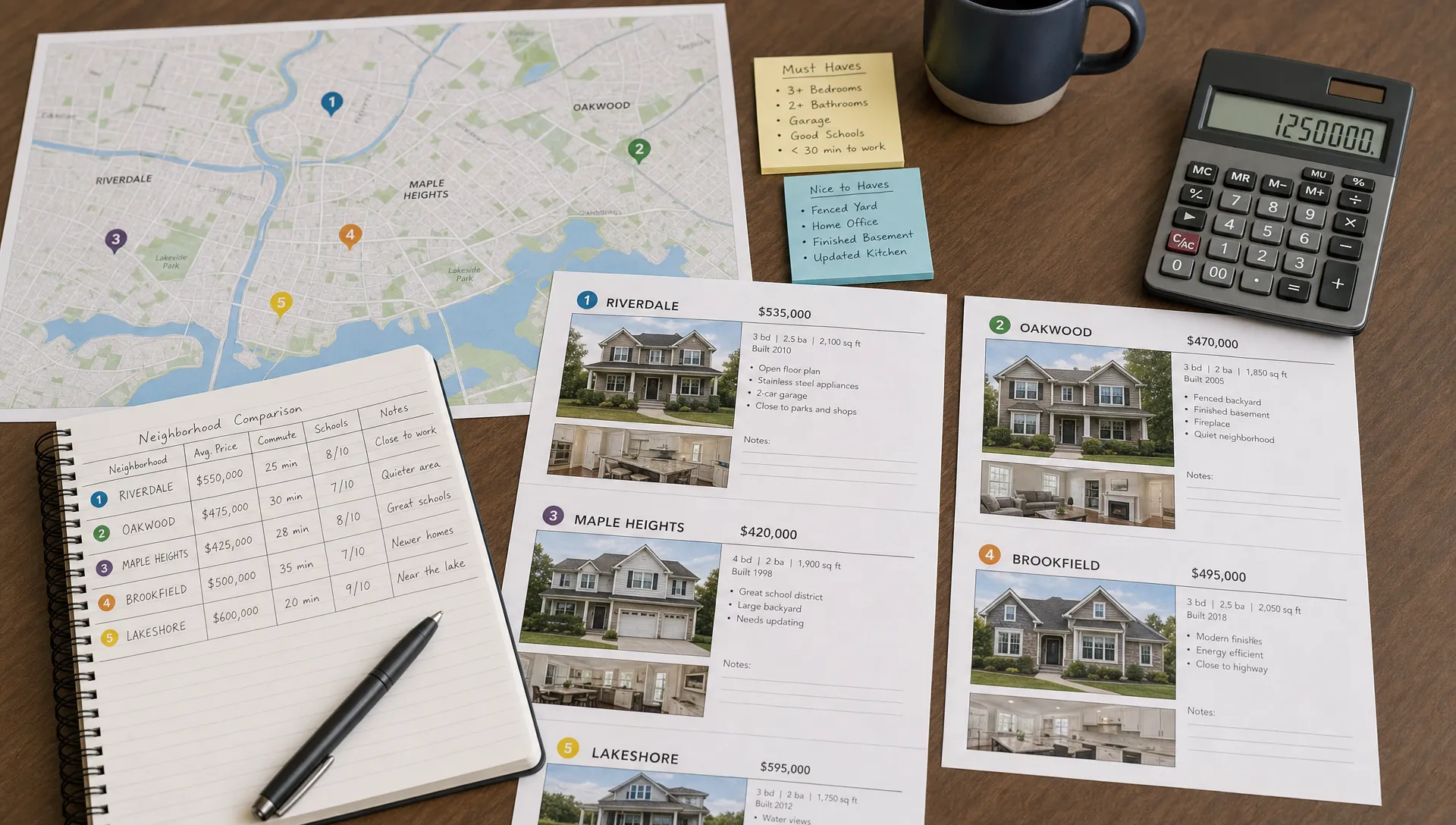
Why should you create a simple scoring system before touring homes?
After several showings, homes start to blur together. One had the better kitchen, another had the better street, and another felt bigger than expected. Without a consistent scoring method, it is easy to overvalue the last home you saw or the one with the best staging.
Use a simple scorecard with categories that reflect your actual priorities. Keep it short enough to use after every showing.
| Category | Score range | What to evaluate |
|---|---|---|
| Location fit | 1 to 5 | Commute, neighborhood feel, daily convenience |
| Layout and function | 1 to 5 | Room flow, storage, work-from-home space, future flexibility |
| Condition | 1 to 5 | Roof, systems, windows, visible maintenance, repair concerns |
| Total cost | 1 to 5 | Payment, taxes, HOA, utilities, likely improvements |
| Resale confidence | 1 to 5 | Broad appeal, lot, location, unusual features |
Do not score only the exciting parts. A beautiful kitchen cannot fix a location that does not work. A large yard may not be worth it if maintenance is unrealistic. The goal is not to turn buying into a spreadsheet decision, but to make sure your emotions are balanced by structure.
For a deeper system, you can use NetRealtyNow’s guide to compare homes for sale listings faster before you begin touring heavily.
Batch showings by area and purpose
Showings can waste a surprising amount of time when they are scheduled one by one across multiple areas. Instead, group properties by geography and purpose whenever possible.
For example, you might schedule three homes in one neighborhood on a Saturday morning to compare value within that specific area. Another day, you might tour a condo, townhouse, and single-family home to clarify which property type fits your lifestyle best.
Before each showing, prepare a short question list. Ask about the age of major systems, known repairs, utility costs, HOA rules, seller timeline, and whether there are offer deadlines. If a property is vacant, ask how long it has been vacant and whether utilities are active. If the home has recent updates, ask whether permits were required and completed.
After each showing, record notes immediately. Photos can help, but written notes are often more useful. Capture your first impression, concerns, likely costs, and whether the home belongs in your top tier, maybe tier, or no tier.
What hidden decision factors should you watch for when buying property?
Some properties look efficient to search because the listing information is simple. In reality, they may require extra due diligence. This is especially true for condos, older homes, rural properties, investment properties, and land.
Condos require reviewing HOA dues, reserves, rental restrictions, pet rules, parking, insurance coverage, and special assessment history. Older homes may require closer attention to electrical systems, plumbing, roof age, foundation condition, and prior renovations. Rural properties may involve wells, septic systems, private roads, propane, easements, and internet availability.
Vacant land is a different category altogether. A parcel can look affordable online but become expensive or unusable if zoning, access, soil conditions, utilities, setbacks, or environmental restrictions do not support your plans.
Efficient searching means identifying these issues before you spend too much time on a property. When a listing lacks key details, save your enthusiasm until the missing information is confirmed.
When should you adjust your home search criteria?
If you have searched for several weeks and nothing fits, do not just keep refreshing. Use the market feedback to refine your strategy.
If every suitable home is above your budget, your price range may need adjustment or your location may need to expand. If homes in your target area sell before you can tour them, your alert and showing process may be too slow. If every home you like requires major updates, your expectations for condition may be out of sync with the neighborhood price point.
A useful weekly review should answer three questions: What did we see, what did we miss, and what did we learn? This keeps your search active rather than repetitive.
Sometimes the best move is to widen your map. Sometimes it is to remove a preference that is not truly essential. Sometimes it is to pause and get clearer on financing. The point is to let real market data guide your next step.
Frequently Asked Questions
What is the fastest way to search homes and property for sale? The fastest method is to combine a strict saved search, instant alerts, map-based boundaries, and a simple comparison scorecard. This reduces noise while helping you act quickly on homes that match your true must-haves.
Should I search multiple real estate websites? Yes, but do it with purpose. Use MLS-connected data for accuracy, major portals for browsing and saved searches, and local sources for occasional discovery. Checking too many sites without a system can waste time.
How often should I check new listings? If you are actively buying in a competitive market, check strict-search alerts as soon as they arrive and review broader alerts daily or weekly. Your urgency should match your timeline and local market speed.
How do I avoid wasting time on the wrong homes? Define your budget, location boundaries, property type, and deal breakers before searching. Then read listing signals such as days on market, price history, remarks, HOA costs, and missing photos before scheduling a showing.
Are “near me” home searches accurate enough? They are useful for starting broad, but they are not always precise enough for serious buying. Replace broad radius searches with map boundaries based on commute, schools, daily errands, flood risk, and neighborhood-specific price patterns.
Search smarter with the right real estate support
A more efficient home search starts with better structure, but it also helps to have reliable real estate guidance when you are ready to act. NetRealtyNow offers flat fee MLS listing services, full-service brokerage options, and buyer commission rebates in the states where it is licensed.
If you are buying, selling, or preparing to do both, visit NetRealtyNow to explore options that can help you navigate the market with more confidence and less wasted effort.