
A flat fee listing can be one of the simplest ways to reduce the cost of selling a home, but only if you understand what the fee does and does not cover before you sign. The advertised price is not always the full financial picture. Some costs are paid upfront, some are optional, some show up at closing, and some are not controlled by the listing provider at all.
A flat fee listing cost is a fixed amount paid to a licensed broker or listing service for placing a property on the MLS and providing selected services, differing from traditional percentage-based commissions. While a flat fee package can significantly reduce listing-side expenses compared to a 3 percent commission that might be $12,000 on a $400,000 home, the advertised price is often not the total cost of selling. Sellers must understand that the full financial picture includes upfront listing fees, optional add-ons, closing-related charges, and other seller-paid transaction costs, which should all be clarified before signing.
The goal is not to find the lowest number on a pricing page. The goal is to understand your expected net proceeds, the level of support you will receive, and the responsibilities you are agreeing to take on as the seller.
What a flat fee listing cost actually means
A flat fee listing cost is the fixed amount you pay a licensed broker or listing service to place your property on the MLS and provide the services included in your selected package. Unlike a traditional percentage-based listing commission, the listing-side fee is not tied to the final sale price.
That distinction matters. If your home sells for $400,000, a 3 percent listing commission would equal $12,000. A flat fee package might cost far less, but the package may also require you to handle more of the process yourself. The savings are real when the service level matches your ability, time, and comfort with pricing, showings, offers, paperwork, and deadlines.
A flat fee listing is also not the same as a no-cost sale. Sellers may still have closing costs, title or settlement fees, transfer taxes, mortgage payoff costs, HOA document fees, repairs, concessions, moving expenses, and, in some cases, buyer broker compensation.
If you are new to the model, it helps to first understand what flat fee MLS realty services actually include so you can separate the listing package from the broader cost of selling.
The main cost buckets to review before you sign
Most flat fee listing costs fall into four categories: upfront listing fees, optional add-ons, closing-related charges, and seller-paid transaction costs. A good agreement makes each category clear.
| Cost bucket | What it means | Why it matters before signing |
|---|---|---|
| Upfront flat fee | The base price for the listing package | This is usually the advertised number, but it may not include every service you expect |
| Optional add-ons | Extra services such as photos, lockbox, signage, extra changes, or added support | These can be worth paying for, but they should be disclosed before you commit |
| Closing or compliance fees | Fees due only if the home sells or reaches closing | These can reduce your savings if they are not included in the advertised price |
| Seller transaction costs | Costs tied to the sale itself, such as title, taxes, repairs, concessions, and possible buyer broker compensation | These are part of your net proceeds calculation, even if they are not charged by the listing company |
The most important question is simple: What is the total amount I may pay from listing to closing if the home sells?
What is usually included in the base flat fee
Flat fee packages vary by broker, state, MLS, and service level. Still, a base package commonly includes MLS entry through a licensed broker, a set listing term, property data entry, a limited number of photos, and syndication from the MLS to major real estate websites.
Some providers also include basic broker support, required disclosures, offer forwarding, listing edits, or guidance on pricing and presentation. Others keep the base package lean and charge separately for support beyond MLS placement.
Before signing, confirm these details in writing:
- How long the listing stays active on the MLS
- Which MLS your property will be entered into
- How many photos are included
- How many listing changes are included
- Whether your listing will syndicate to public real estate portals
- Whether broker support is included and how support is delivered
- Whether forms, disclosures, and offer documents are included
- Whether cancellation or withdrawal is allowed and whether there is a fee
Do not assume that a feature is included just because another company includes it. Flat fee listing services are not identical, and the cheapest package may not be the best fit if it leaves you without help when an offer arrives.
Costs that are often separate from the advertised fee
The costs that surprise sellers are usually not mysterious. They are often listed in the terms, but many sellers do not slow down long enough to read them carefully.
| Possible extra cost | Why it may appear | What to ask |
|---|---|---|
| Listing extension | Your home stays on the market longer than the original term | What happens if the listing expires before I sell? |
| Extra listing edits | You need repeated price changes, photo updates, or description revisions | How many changes are included? |
| Professional photography | The base package may require you to provide photos | Do you offer photography guidance or vendor options? |
| Yard sign or lockbox | Physical marketing tools may not be included | Are these available, and who installs or manages them? |
| Showing service | Some sellers want centralized scheduling | Is showing coordination included or separate? |
| Contract review | Basic MLS placement may not include negotiation or contract help | Will a broker help review offers? |
| Closing coordination | Some packages stop after offer acceptance | Who helps track deadlines through closing? |
| Cancellation or withdrawal fee | Some providers charge if you end the listing early | Can I cancel, and what will it cost? |
| Success fee or closing fee | Some low upfront packages charge at closing | Is anything due when the property sells? |
A low upfront price is not automatically a bad thing. It can be a smart choice for an experienced seller who wants MLS exposure and can manage the sale independently. But if you expect advice, negotiation help, or transaction coordination, make sure that support is included or priced clearly.
Buyer broker compensation is a separate decision
One of the biggest misconceptions about flat fee listing costs is that the flat fee replaces every commission-related cost. It usually replaces the listing broker side of the cost, not necessarily any compensation or concessions you choose to offer to a buyer or buyer broker.
Since the 2024 industry rule changes, buyer broker compensation is handled differently in many MLS environments. Sellers can still evaluate whether offering buyer-side compensation or buyer concessions makes sense, where allowed, but the terms should be discussed carefully and documented properly. The key point for your budget is that this cost is separate from the flat fee you pay for the listing service.
Before you sign a listing agreement, ask these questions:
- Am I required to offer buyer broker compensation?
- If I choose to offer it, how is it communicated and documented?
- Can I change my decision later if market conditions shift?
- Will the broker help me evaluate offers that include buyer requests for concessions?
- How does this affect my estimated net proceeds?
The right answer depends on your market, price point, demand, and negotiation strategy. Do not treat buyer-side costs as an afterthought. A 2 percent to 3 percent buyer-side amount on a high-value home can be far larger than the flat listing fee itself.
How flat fee savings show up in your net proceeds
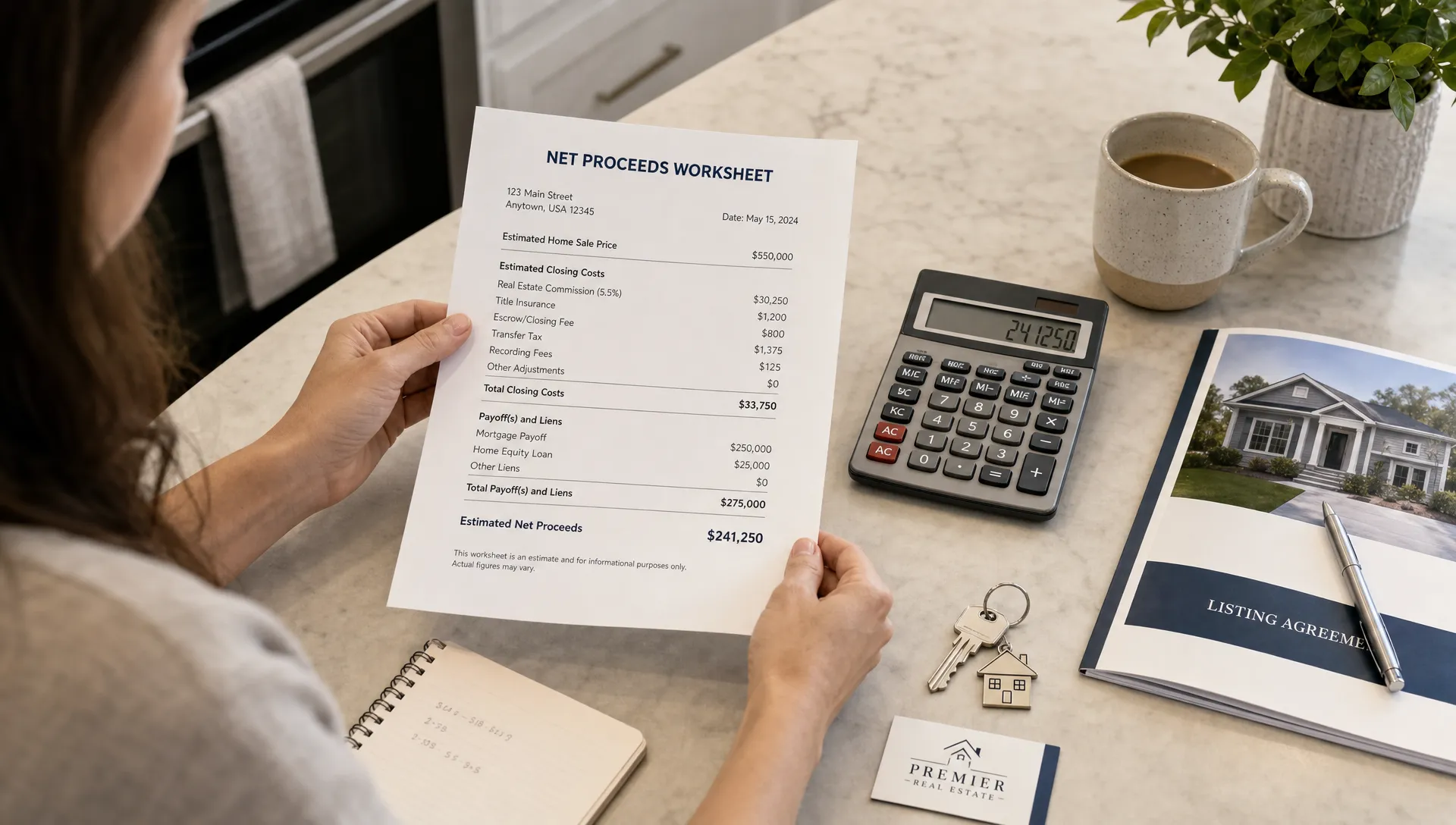
The cleanest way to compare options is with a net sheet. Do not compare only the upfront fee against a percentage commission. Compare your estimated net after all relevant costs.
Here is a simplified example for illustration only.
| Item | Traditional listing model | Flat fee listing model |
|---|---|---|
| Estimated sale price | $500,000 | $500,000 |
| Listing-side cost | 3 percent, or $15,000 | Flat fee, for example $799 |
| Buyer-side compensation or concessions | Separate seller decision | Separate seller decision |
| Title, settlement, taxes, repairs, payoff | Varies by transaction | Varies by transaction |
| Gross listing-side savings before add-ons | Not applicable | $14,201 in this example |
This does not mean every seller saves exactly that amount. If you purchase add-ons, pay a closing fee, accept a lower offer due to weak pricing, or need more support later, the savings can shrink. On the other hand, if your home is priced well, marketed properly, and you are comfortable managing seller responsibilities, a flat fee listing can preserve a meaningful amount of equity.
The formula is straightforward:
| Step | Calculation |
|---|---|
| Start | Expected sale price |
| Subtract | Mortgage payoff and liens |
| Subtract | Flat fee package and add-ons |
| Subtract | Any buyer broker compensation or seller concessions |
| Subtract | Title, settlement, transfer, HOA, repair, warranty, and moving costs |
| Result | Estimated seller net proceeds |
A reliable provider should be willing to help you understand what is included in its own fee. For third-party costs, your title company, settlement provider, attorney, or local professional can provide state-specific estimates.
The agreement terms that deserve extra attention
Before you sign, read the listing agreement the same way you would read a contract for any major financial decision. The price matters, but the terms control your options if the sale does not go exactly as planned.
Pay close attention to the listing term. A package that lasts three months may be enough in a fast market, but a slower market may require an extension. If extensions cost extra, include that possibility in your budget.
Review cancellation language carefully. Some sellers assume they can cancel anytime without cost, then discover that withdrawal fees, admin fees, or post-cancellation restrictions apply. If you may switch strategies later, such as moving from self-service to full-service brokerage, you need to understand your flexibility.
Look for any fee due at closing. Phrases like transaction fee, compliance fee, success fee, document fee, or broker closing fee should be clear. These fees are not always unreasonable, but they should never be a surprise.
Also confirm who handles communication after an offer arrives. Offer negotiation, inspection issues, appraisal gaps, financing deadlines, and closing delays are often where a sale becomes more complex. If your package includes only MLS exposure, you may need to handle these issues yourself or pay for additional help.
For a broader due diligence checklist, review how to compare flat fee brokers before you list and use it alongside the pricing terms you are evaluating.
When a higher flat fee can be the better deal
It is easy to focus on the lowest advertised fee, especially when the whole point is to save money. But the lowest upfront cost is not always the lowest total cost.
A slightly higher flat fee may be a better value if it includes better MLS placement, more photos, stronger broker availability, more listing changes, disclosure support, offer guidance, or contract negotiation help. These services can matter if you are selling an unusual property, pricing in a shifting market, managing multiple offers, or dealing with inspection and appraisal negotiations.
Think of it like planning the rest of a move. The visible cost may be the listing fee, but there are practical logistics around the sale too, such as movers, storage, temporary housing, travel, and, for some work-related relocations, premium business transportation like executive chauffeur services. Keeping each category separate helps you judge the true cost of the transition instead of blaming every expense on the listing model.
The same logic applies to flat fee real estate. You are not only buying MLS access. You may also be buying speed, clarity, compliance, and support at the moments when mistakes can become expensive.
Match the service level to your situation
The best flat fee listing cost is the one that fits your experience and risk tolerance. A seller who has sold several homes, understands local pricing, and can respond quickly to buyers may be comfortable with a lean MLS package. A first-time seller may prefer a more supported option.
| Seller situation | Likely best fit | Why |
|---|---|---|
| Experienced seller in a high-demand market | Basic or self-service flat fee MLS | MLS exposure may be the main need |
| Busy seller with limited time | Agent-assisted flat fee option | Support can prevent delays and missed details |
| First-time seller | More guided flat fee package or full-service option | Paperwork, negotiations, and deadlines may require help |
| Unique property or uncertain pricing | Higher-support brokerage model | Pricing and positioning can affect final proceeds |
| Seller relocating quickly | More coordination and communication support | Speed and responsiveness may matter more than the lowest fee |
If you are deciding between a flat fee package and a more traditional service model, it may help to compare flat fee listing versus a full-service broker from both a cost and value perspective.
Red flags in flat fee listing pricing
Most reputable flat fee providers are transparent about costs. Be cautious if the pricing page is vague, the agreement is hard to obtain, or the company will not clearly explain what happens after an offer is received.
Watch for these warning signs:
- The advertised fee is low, but the agreement adds mandatory closing fees
- The provider does not clearly identify the licensed broker responsible for the listing
- MLS access is described vaguely without naming the relevant MLS or coverage area
- Cancellation terms are missing or difficult to understand
- The company promises unrealistic sale prices or guaranteed results
- Support is marketed broadly but not defined in the agreement
- You cannot tell whether offer negotiation or contract help is included
A flat fee listing should give you more control, not more confusion. If you cannot determine the total cost before signing, ask for clarification in writing.
Questions to ask before you sign
A short conversation before signing can prevent expensive misunderstandings later. Use these questions to compare providers and packages:
- What is the total upfront cost?
- Is any fee due at closing?
- What exact services are included in the base package?
- What services cost extra?
- How long is the listing term?
- What happens if I need to change the price or photos?
- Who reviews my listing before it goes live?
- Who receives inquiries from agents and buyers?
- Do you help with offers, counteroffers, inspection issues, and closing deadlines?
- Can I upgrade to a higher-support service if needed?
The answers should help you choose a package based on total value, not just the first number you see.
Frequently Asked Questions
What does a flat fee listing cost include? A flat fee listing cost usually includes MLS placement through a licensed broker and the services listed in your selected package. Depending on the provider, it may also include listing edits, photo allowances, syndication, basic broker support, forms, or offer forwarding. Always confirm the exact scope in writing.
Are buyer agent fees included in a flat fee listing? Usually no. The flat fee typically covers the listing-side service. Any buyer broker compensation, buyer concessions, or related negotiation terms are separate decisions and should be reviewed as part of your net proceeds estimate.
Can a flat fee listing have hidden costs? It can if you do not review the agreement carefully. Common additional costs may include listing extensions, extra edits, signs, lockboxes, contract support, cancellation fees, compliance fees, or closing fees. Reputable providers should disclose these before you sign.
Is the cheapest flat fee listing always best? Not always. The cheapest option may work for an experienced seller who only needs MLS exposure. Sellers who want help with pricing, negotiations, disclosures, or closing coordination may be better served by a package with more support.
How do I know if I am actually saving money? Build a net sheet. Compare your expected sale price minus all selling costs, including the flat fee, add-ons, concessions, possible buyer-side costs, settlement fees, repairs, and moving expenses. The best option is the one that protects your net proceeds and fits your ability to manage the sale.
Get clear on your listing costs before you commit
Flat fee listing costs are not complicated once you separate the upfront fee from the total cost of selling. Before you sign, make sure you understand what is included, what costs extra, what may be due at closing, and how much support you will receive when offers and deadlines arrive.
NetRealtyNow offers flat fee MLS listing services and full-service real estate brokerage options for sellers who want to reduce commission costs while maintaining strong property exposure. If you are ready to compare your options, review the services available through NetRealtyNow and choose the level of support that fits your sale.