
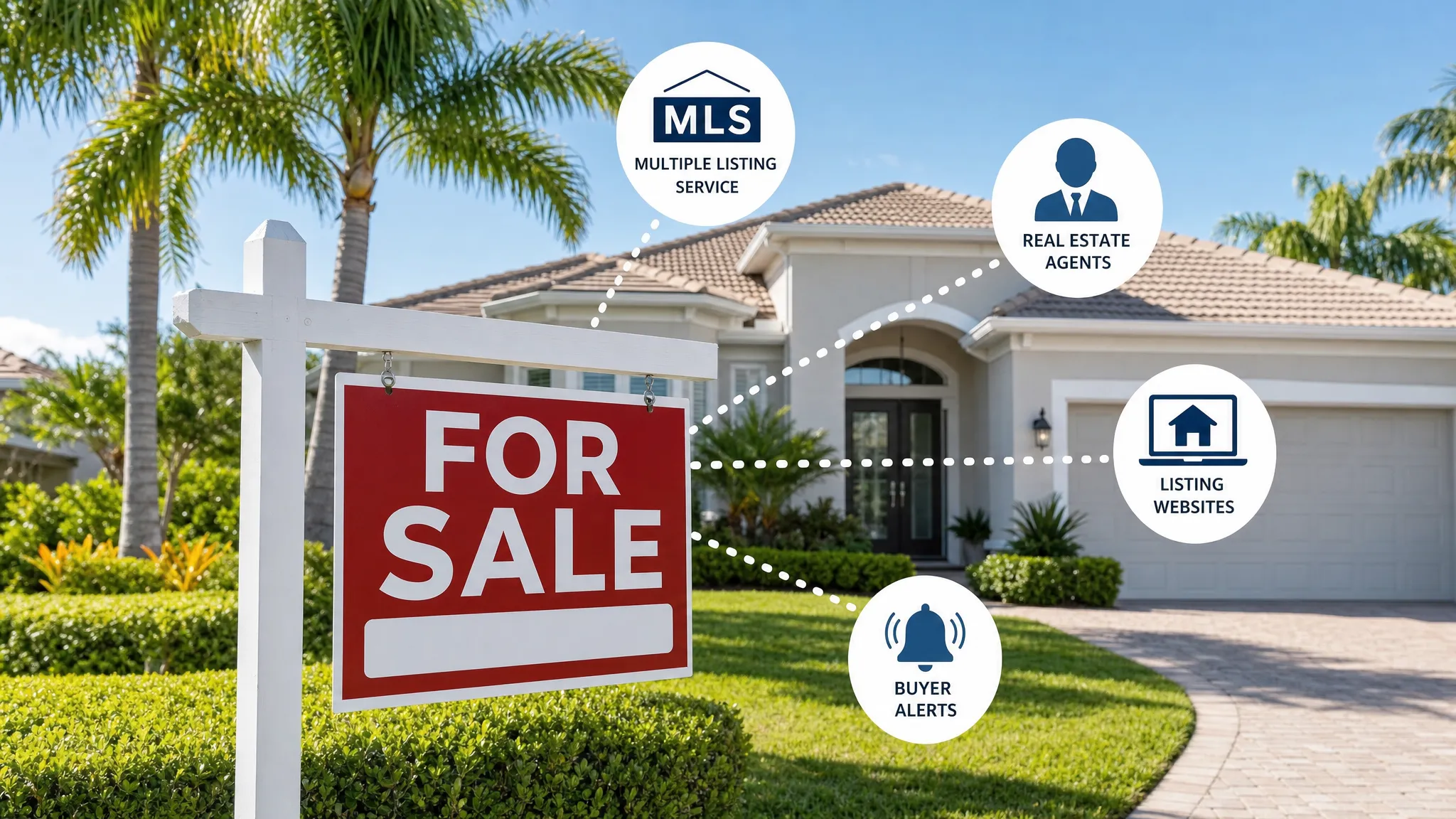
Most buyers do not discover a Florida home because they happened to drive past the sign. They find it because the listing data moved through a network of MLS systems, agent tools, brokerage websites, real estate portals, saved searches, and buyer alerts.
That is why understanding how Florida real estate listings really reach buyers matters. A listing is not just a public advertisement. It is a structured data package that tells agents, buyers, search engines, and listing platforms what the property is, where it is, how it is priced, and why it deserves attention.
For sellers, the goal is not simply to “get online.” The goal is to get accurate, compelling listing information into the channels serious buyers actually use, then make the home strong enough to earn clicks, saves, showing requests, and offers.
The modern Florida buyer starts online, but not always in the same place
Florida attracts many types of buyers: local move-up buyers, retirees, investors, military families, remote workers, second-home buyers, and out-of-state relocators. Some are watching a neighborhood for months. Others fly in for one weekend and need to tour only the best-fit homes.
The National Association of Realtors has consistently found that the internet is central to the home search process, with buyers using online sources heavily before and during their search. But “online” is not one single place. A buyer might first notice a home on Zillow, save it through a brokerage app, ask their agent about it through the MLS, and compare it later on Realtor.com or Redfin.
Behind all of those touchpoints is one central concept: reliable listing data. The more complete, accurate, and strategically presented that data is, the better chance the property has of reaching the right buyers at the right moment.
Step 1: The listing starts with the local MLS
In most Florida markets, the Multiple Listing Service, usually called the MLS, is the core distribution point for residential listings. The specific MLS depends on the region. For example, different parts of Florida may be served by systems connected to local Realtor associations, regional MLS organizations, or large statewide and regional data networks.
When a home is listed through a licensed broker, the property details are entered into the appropriate MLS according to that MLS’s rules and fields. This is where the listing becomes more than a short description and a few photos. It becomes structured data that can be searched, filtered, shared, updated, and syndicated.
Typical MLS listing information includes:
- Property address, subdivision, county, and map location
- Price, property type, bedrooms, bathrooms, and square footage
- Lot size, year built, parking, pool, waterfront, and HOA details
- Public remarks, agent remarks, showing instructions, and disclosures
- Photo gallery, status, open house information, and price changes
For Florida homes, some fields carry extra weight. Buyers often care about flood zones, insurance considerations, roof age, condo fees, reserves, rental restrictions, waterfront features, hurricane protection, and distance to beaches, schools, airports, or medical centers. If those details are missing or unclear, buyers may skip the listing or ask their agent to prioritize homes with cleaner information.
A flat fee MLS model can help sellers access this distribution without using a traditional full-commission listing structure. NetRealtyNow offers flat fee MLS listing services for sellers who want broad MLS exposure while controlling commission costs.
Step 2: Buyer agents see the listing through MLS searches and alerts
One of the most important ways Florida real estate listings reach buyers is through agents. Serious buyers often work with a buyer’s agent who sets up MLS searches based on the buyer’s budget, preferred areas, property type, lifestyle needs, and timing.
When a new listing matches those criteria, it can appear in the agent’s dashboard or trigger an email alert to the buyer. That alert may happen quickly, sometimes before the listing gains traction on major public portals.
This is why pricing and field accuracy matter so much. A buyer searching for homes under $550,000 will not see a home priced at $555,000 unless their agent broadens the range. A buyer looking for a pool home may never see a listing if the pool field is incomplete. A condo buyer searching for a pet-friendly building may skip listings that fail to explain restrictions clearly.
The MLS also helps agents evaluate whether a listing is worth showing. Agents look beyond the public description. They may review private remarks, showing availability, seller instructions, status changes, comparable sales, days on market, and whether the listing appears complete and credible.
In other words, reaching buyers through the MLS is not only about visibility. It is about confidence. A complete, professional listing gives agents fewer reasons to hesitate.
Step 3: Brokerage websites and IDX feeds expand visibility
After a listing is active in the MLS, it can appear on participating brokerage websites through IDX, which stands for Internet Data Exchange. IDX allows brokers and agents to display MLS listings on their own sites, subject to local MLS rules.
This is a major reason one MLS listing can appear across many real estate websites. A buyer searching on a local brokerage site in Tampa, Sarasota, Orlando, Miami, Jacksonville, or Naples may be viewing MLS-fed data, even if they are not directly inside the MLS.
IDX exposure is especially useful because many buyers trust local broker and agent websites for neighborhood-level searches. These sites may include map tools, saved search features, community pages, school filters, and market context. A strong MLS listing can therefore travel far beyond the original broker’s website.
The quality of the original listing still matters. IDX feeds distribute the data provided. They do not magically fix weak photos, vague descriptions, missing fields, or an unrealistic price.
Step 4: Major real estate portals amplify the listing
Large real estate portals such as Zillow, Realtor.com, Redfin, and Homes.com are often where consumers spend the most time browsing. These platforms can introduce a property to buyers who are casually watching the market, relocating from another state, or comparing areas before contacting an agent.
However, portals are not separate from the listing ecosystem. In many cases, portal data originates from MLS feeds, broker feeds, syndication agreements, or other approved data sources. That means the MLS often acts as the source of truth, while portals act as high-traffic amplifiers.
A property can receive wide exposure, but exposure alone does not guarantee buyer interest. Portal users make fast decisions based on the first photo, price, map location, monthly cost estimates, property facts, and whether the home looks worth saving. If the listing looks incomplete or overpriced compared with nearby homes, buyers may scroll past it.
| Channel | How it reaches buyers | Why it matters for Florida sellers |
|---|---|---|
| Local MLS | Agents and brokerages access structured listing data | Reaches serious buyers working with agents |
| Buyer alerts | Saved searches notify buyers when a match appears | Creates early attention for fresh listings |
| IDX websites | Brokerage and agent sites display MLS-fed listings | Expands local and regional web visibility |
| Major portals | High-traffic consumer platforms display listing information | Reaches out-of-area buyers and casual searchers |
| Social and email marketing | Agents and sellers share the listing with targeted audiences | Adds momentum, especially for lifestyle-driven homes |
What makes Florida listing exposure different?
Florida is not a one-size-fits-all market. A listing in Miami Beach, Sarasota, The Villages, Orlando, Jacksonville, or Fort Lauderdale may attract very different buyer pools. The way a listing reaches buyers is similar across markets, but the details that motivate buyers can vary dramatically.
A waterfront buyer may care about seawall condition, dock access, bridge clearance, and flood insurance. A condo buyer may focus on monthly fees, reserves, rental policies, milestone inspections, parking, and building amenities. A family relocating to Central Florida may care about school zones, commute routes, and insurance costs. An investor may search by rental potential, short-term rental rules, and carrying costs.
Florida also has strong seasonal search patterns. In many areas, buyer activity can increase when snowbirds and out-of-state buyers are planning winter stays, retirement moves, or second-home purchases. But local market conditions matter too. Inventory, mortgage rates, insurance premiums, and regional job growth can all affect how quickly buyers respond.
| Florida listing factor | Why buyers care | Seller takeaway |
|---|---|---|
| Flood zone and elevation | Insurance and risk concerns affect affordability | Make relevant information easy to verify |
| HOA or condo fees | Monthly costs influence buyer qualification | Clearly explain fees and included amenities |
| Roof age and hurricane features | Insurance and maintenance concerns are common | Highlight known upgrades accurately |
| Rental restrictions | Investors and second-home buyers need clarity | Avoid vague language about rental potential |
| Waterfront and outdoor features | Lifestyle value can drive demand | Use photos and descriptions that show the benefit |
Why the first 48 hours can shape buyer perception
When a Florida listing goes live, it often receives a burst of attention from saved searches, agent alerts, and portal notifications. That early window is important because buyers who have been waiting for a home like yours may act quickly.
If the home is priced well and presented professionally, the first wave can produce saves, inquiries, showings, and possibly early offers. If the listing is missing photos, has confusing details, or enters the market at a price that does not match comparable homes, buyers may ignore it. Later price reductions can help, but they do not always recreate the excitement of a strong launch.
This is why sellers should prepare before the listing is activated. The MLS launch should not be treated as a test run. Photos should be ready, listing fields should be reviewed, showing access should be planned, and the pricing strategy should be supported by local data.
What makes buyers click, save, and schedule a showing?
Visibility gets a listing in front of buyers. Presentation gets them to care.
Photos are often the first filter. In a competitive Florida market, buyers expect bright, clear images that show the home’s layout, condition, outdoor areas, and strongest lifestyle features. For condos, that may include the view, balcony, lobby, amenities, parking, and building exterior. For single-family homes, it may include curb appeal, kitchen, primary suite, pool, lanai, yard, roofline, and neighborhood setting.
Pricing is the second major filter. Buyers compare homes side by side. If a home is priced above similar active and recently sold properties, the listing needs a clear reason, such as superior condition, location, upgrades, lot, view, or amenities. If that reason is not obvious, buyers may assume the seller is unrealistic.
The description also matters, but not because buyers want flowery language. They want useful context. A strong description explains what the photos cannot fully communicate: how the home lives, what has been improved, what is nearby, and why the property fits a specific lifestyle.
If you are preparing a listing, NetRealtyNow’s guide on how to make property listings stand out online covers practical ways to improve photos, pricing, and listing details before buyers see the property.
Social media helps, but it does not replace MLS exposure
Social media can be a powerful supplement for Florida listings, especially when a property has visual appeal or lifestyle value. A pool home, waterfront condo, golf community villa, or walkable downtown property may perform well in short-form posts, neighborhood groups, email campaigns, and paid social ads.
But social media has limits. Posts move quickly, audiences are inconsistent, and many viewers are not active buyers. The MLS and related listing feeds remain important because they connect the home to people who are actively searching, often with financing, timelines, and agent representation already in place.
The best strategy is usually layered. Use the MLS as the distribution foundation, portals and IDX sites for broad online reach, and social media for extra attention and storytelling.
Common myths about how Florida listings reach buyers
| Myth | Reality |
|---|---|
| “If it is on one website, every buyer will see it.” | Buyers use different apps, agents, alerts, and brokerage sites. Broad distribution matters. |
| “The portal listing is the original listing.” | The MLS or broker feed is often the source that powers many public displays. |
| “More views always mean more offers.” | Views only help if pricing, photos, condition, and access support buyer action. |
| “A yard sign is enough in a hot market.” | Signs help locally, but many Florida buyers search remotely before visiting. |
| “All listing services are the same.” | Accuracy, MLS access, support, syndication, and seller guidance can vary. |
How sellers can improve distribution before going live
A seller cannot control every algorithm, buyer preference, or market shift. But sellers can control the quality of the listing package that enters the system.
Start with accurate data. Double-check square footage, property type, association details, tax information, included appliances, parking, and room features. If there are upgrades, document them clearly. If there are restrictions, avoid hiding them. Surprises can slow down a sale later.
Next, think like a search filter. Buyers do not only read descriptions. They filter by price, location, property type, beds, baths, pool, waterfront, garage, HOA, school area, and other criteria. If a key feature is not entered correctly, the right buyer may never see the home.
Finally, make the listing easy to act on. Showing instructions should be clear. Seller response time should be fast. Disclosures and known property details should be organized. A buyer who is choosing between several homes may favor the one that feels easiest to understand and tour.
Frequently Asked Questions
Do Florida real estate listings automatically appear on Zillow and other portals? Not always automatically in the way sellers imagine. Many listings reach portals through MLS feeds, broker feeds, or syndication settings. The exact path depends on the broker, MLS, and platform rules.
Is the MLS still important if buyers search on public websites? Yes. The MLS often powers agent searches, saved buyer alerts, IDX websites, and data feeds to public platforms. Public sites are important, but MLS exposure remains a key foundation for reaching serious buyers.
What is the biggest mistake Florida sellers make with online listings? One of the biggest mistakes is launching with weak photos, incomplete fields, or unclear property details. In Florida, missing information about HOA fees, condo rules, roof age, flood considerations, or waterfront features can reduce buyer confidence.
Can a flat fee MLS listing reach real buyers? Yes, when it is properly entered into the MLS and syndicated through the right channels. The seller may handle more of the process than with a traditional full-service listing, but MLS exposure can still place the home in front of agents and active buyers.
How fast should a new Florida listing get attention? Many listings receive their strongest initial online attention in the first few days because of saved searches and new-listing alerts. If there is little activity early, sellers should review price, photos, showing access, and listing completeness.
Put your Florida listing where buyers are already looking
Florida buyers are not all searching the same way, but most are connected to the same listing ecosystem. The MLS feeds agent searches, brokerage websites, portals, alerts, and buyer conversations. When your listing data is accurate and your presentation is strong, that ecosystem can work much harder for you.
NetRealtyNow helps sellers market homes through flat fee MLS listings and full-service brokerage options, with broker support and broad online exposure. If you are preparing to sell in Florida, start with the channel that still drives serious buyer visibility: the MLS, supported by the right pricing, photos, and listing strategy.